
The Forgotten Emperor: How India’s Napoleon Vanished from History
The gold coin gleams under museum lights, its surface worn by sixteen centuries but its message unmistakable. On one side, a warrior emperor sits cross-legged, playing a veena, the classical Indian stringed instrument. On the reverse, Sanskrit letters proclaim him “King of Kings.” This is all that most people will ever see of Samudragupta—a man who conquered more of India than Alexander the Great conquered of Asia, who transformed a modest kingdom into a vast empire, and who somehow became history’s most successful disappearing act.
While schoolchildren worldwide learn of Alexander, Napoleon, and Caesar, Samudragupta remains virtually unknown outside academic circles. Yet the Allahabad Pillar, standing silent witness to his achievements, records military campaigns that rival anything in ancient military history. The inscription carved into that pillar describes victories over dozens of kingdoms, territories stretching from the Himalayas to the southern tip of India, and an administrative system that would sustain what historians call India’s Golden Age.
The question isn’t what Samudragupta accomplished—the evidence is literally carved in stone and struck in gold. The question is why his name disappeared from popular memory while lesser conquerors achieved immortal fame. To understand this vanishing act, we must travel back to fourth-century India, to the courts of Pataliputra, to battlefields stretching across the subcontinent, and to the moment when one man’s vision reshaped Indian civilization.
The World Before
Fourth-century India was a fractured landscape of competing kingdoms, tribal confederacies, and remnant republics. The great Mauryan Empire, which had unified much of the subcontinent under Ashoka over five centuries earlier, had crumbled into regional powers. The Kushanas, who had dominated northern India, were in decline. The Satavahanas of the Deccan had fragmented. Into this political vacuum stepped numerous would-be empire builders, most destined for obscurity.
The Ganges valley, that ancient cradle of Indian civilization, remained the strategic and cultural heartland. Control of this region meant control of the most fertile agricultural lands, the most developed trade networks, and the most prestigious religious and educational centers. The city of Pataliputra, ancient capital of the Mauryas, still commanded respect as a center of learning and administration, though its political power had diminished.
Regional identities were strong. The Licchavis, an ancient republic-turned-kingdom in what is now Bihar, maintained their proud traditions of semi-democratic governance and military prowess. The forest kingdoms of central India preserved their independence through difficult terrain and fierce warriors. The Deccan plateau supported several powerful dynasties who viewed themselves as rightful heirs to ancient southern kingdoms. The coastal regions grew wealthy on maritime trade with Southeast Asia and the Roman Empire.
This was also a time of religious and intellectual ferment. Buddhism, which had dominated during Mauryan times, was evolving and diversifying. Hinduism was experiencing a renaissance, with devotional movements gaining strength. Jainism maintained strong followings in western India. Sanskrit, the language of the educated elite, was entering what scholars would later recognize as its classical period, producing literature that would endure for millennia.
Into this complex, divided world, the Gupta dynasty emerged from relatively modest origins. Chandragupta I, founder of what would become the Gupta Empire, was not born to imperial greatness. Historical accounts vary on the exact nature of his early power, but what is clear is that he understood the value of strategic alliance. His marriage to Kumaradevi, princess of the prestigious Licchavi dynasty, transformed his political prospects. This union combined Gupta ambition with Licchavi legitimacy and military tradition—a combination that would prove formidable in the hands of the right heir.
The political landscape awaited someone with the vision to reunify it, the military genius to conquer it, and the administrative skill to hold it together. The kingdoms and republics of India had no way of knowing that such a figure was about to emerge from the palace at Indraprastha, born to a Gupta king and a Licchavi princess, embodying the union of two powerful traditions.
The Players
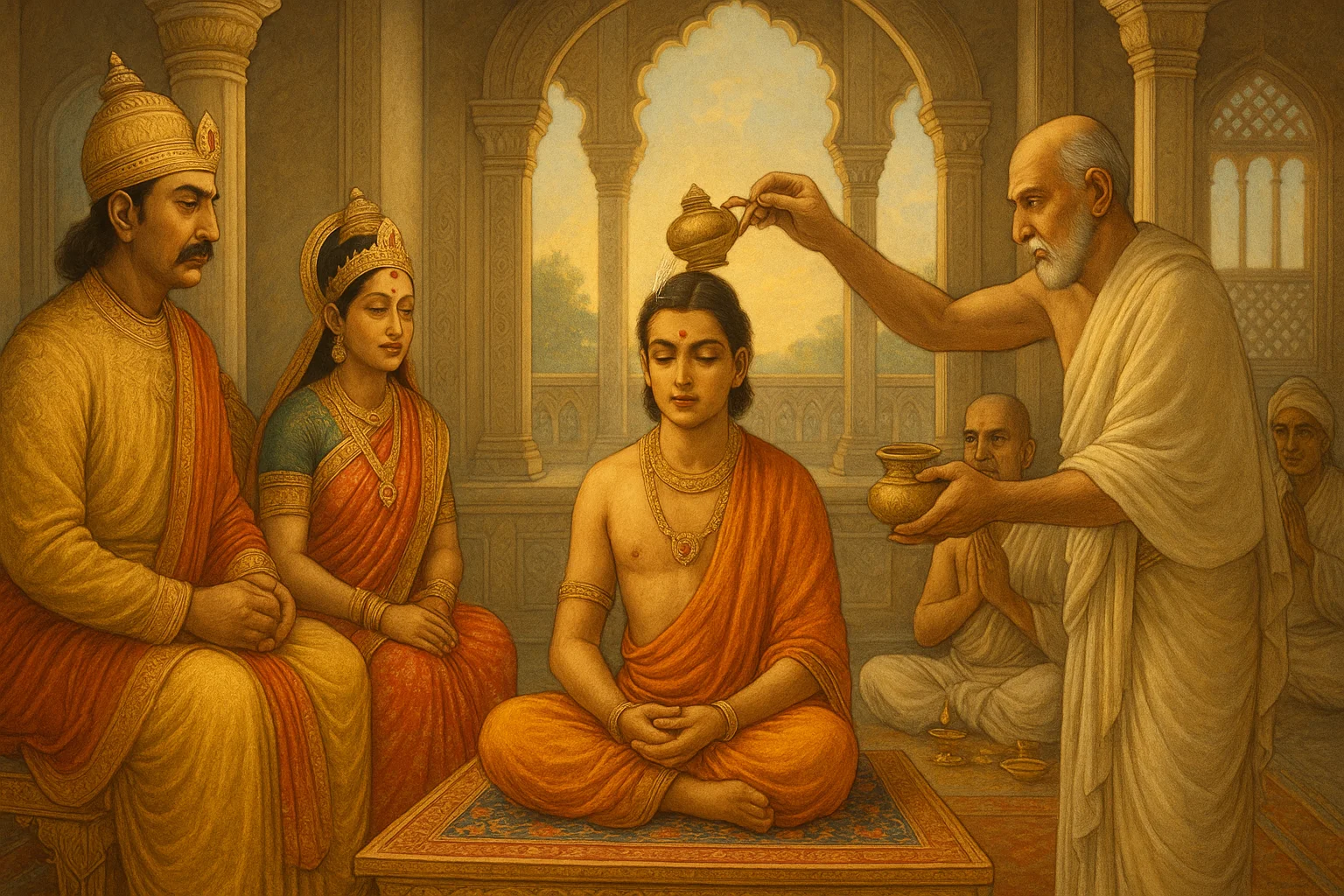
Samudragupta’s story begins in Indraprastha, the ancient city whose name echoed with mythological significance as the capital of the Pandavas in the Mahabharata epic. His birth into the union of Chandragupta I and Kumaradevi gave him a dual inheritance that shaped his destiny. From his father, he received Gupta ambition and whatever territories the dynasty had accumulated. From his mother, he inherited the martial traditions and political legitimacy of the ancient Licchavi republic, one of the few non-monarchical states to maintain its identity into this period.
The sources tell us little about Samudragupta’s childhood or education, but we can infer much from his later accomplishments. He was clearly trained in military arts—his campaigns demonstrate sophisticated understanding of strategy, logistics, and tactics. He must have received extensive education in statecraft, for his administration proved remarkably efficient. His patronage of Sanskrit literature suggests deep familiarity with classical texts. The coins depicting him playing the veena reveal artistic training unusual for a warrior-king. This was no mere soldier elevated to a throne, but a carefully educated prince prepared for greatness.
Chandragupta I’s decision to name Samudragupta as his heir was significant. The Gupta dynasty had not yet established clear rules of succession, and tradition suggests there may have been other potential heirs. The choice of Samudragupta indicates recognition of exceptional qualities—the historical record shows that this recognition was entirely justified. The father who founded the dynasty had chosen well the son who would transform it into an empire.
Kumaradevi, his mother, deserves more attention than she typically receives in historical accounts. As a Licchavi princess, she represented a powerful political alliance, but her influence on her son’s character and education likely went deeper. The Licchavis had maintained republican traditions longer than most Indian states, and their military reputation was formidable. Samudragupta’s later treatment of conquered territories—maintaining many rulers as vassals rather than eliminating them—suggests exposure to Licchavi political philosophy, which emphasized complex networks of alliances rather than absolute centralized control.
Dattadevi, Samudragupta’s spouse, remains a shadowy figure in the historical record, as is frustratingly common for women in ancient Indian history. What we know is that she bore him sons who would continue the dynasty, including the famous Chandragupta II, who would further expand the empire his father built. The exact details of their relationship, her influence on policy, and her role at court are lost to time, though the continuation of Samudragupta’s policies under his son suggests she may have played a role in their education and political formation.
The broader cast of characters in Samudragupta’s story includes the rulers of kingdoms whose names survive only in the Allahabad Pillar inscription. Each represented a independent power with its own traditions, armies, and ambitions. Each believed themselves secure in their territories. Each would learn otherwise. The Pillar records their names—kings of the north who were “violently exterminated,” southern rulers who submitted and paid tribute, frontier kingdoms reduced to vassalage, forest tribes who acknowledged Gupta supremacy. Behind each name lies a story of battle, negotiation, or submission that is now lost, preserved only in the stark accounting of Samudragupta’s conquests.
Rising Tension
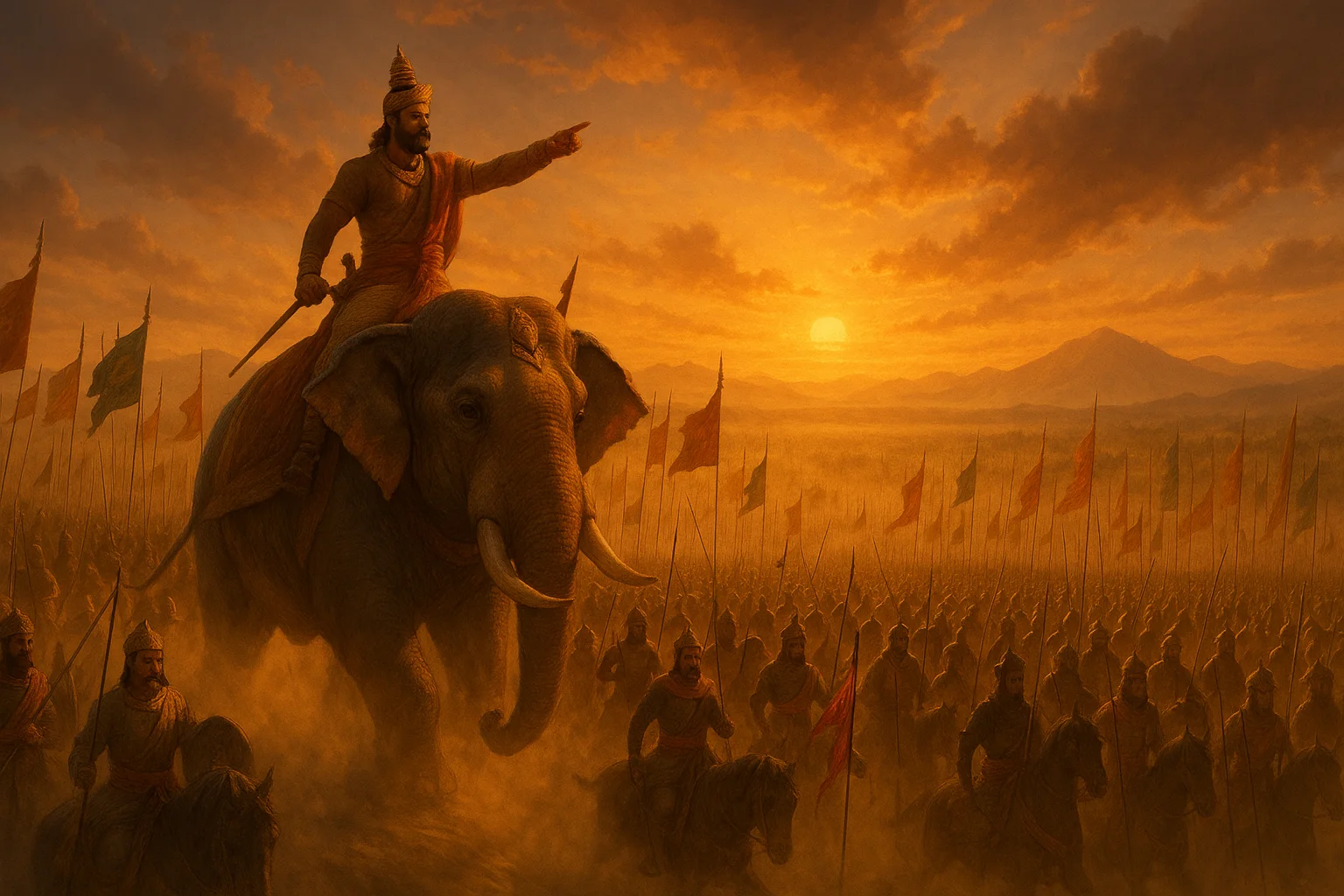
The inherited kingdom that Samudragupta took control of was substantial but not yet an empire. His father Chandragupta I had built a solid foundation, controlling territories in the Ganges valley and benefiting from the Licchavi alliance. But the subcontinent remained fragmented, with powerful kingdoms to the north, south, east, and west viewing themselves as equals or superiors to the Guptas. For an ambitious ruler with imperial vision, this situation was simultaneously an opportunity and a challenge.
The decision to launch systematic military campaigns rather than rest on his inherited position reveals Samudragupta’s character. He could have consolidated, administered efficiently, and passed a stable kingdom to his heirs. Instead, he chose conquest. The question is whether this choice stemmed from personal ambition, strategic necessity, or vision of a unified India under Gupta rule. Historical evidence suggests elements of all three.
The first campaigns established the pattern that would define Samudragupta’s military career. The Allahabad Pillar inscription, our primary source for his conquests, describes a systematic approach that combined overwhelming military force with sophisticated political strategy. The northern kingdoms near his core territories were “violently exterminated”—harsh language that indicates these rulers posed direct threats to Gupta power and were treated accordingly. This was not indiscriminate violence but calculated elimination of potential rivals who could threaten his base of power.
The military machine that Samudragupta assembled drew on multiple traditions. Gupta armies combined infantry, cavalry, and war elephants in the classic Indian military style. The Licchavi connection likely provided skilled warriors and commanders experienced in warfare. As territories fell under Gupta control, their military resources were incorporated into the imperial army, creating a diverse force that could adapt to different terrains and opponents. The logistics required to move such armies across the subcontinent—feeding thousands of soldiers, transporting supplies, coordinating movements across hundreds of miles—demonstrates administrative sophistication matching the military prowess.
The Northern Campaigns
The kingdoms directly north of Gupta territory were the first to feel Samudragupta’s military might. These conquests were brutal by necessity—rulers who could potentially contest Gupta supremacy in the Ganges heartland had to be eliminated, not merely defeated. The Allahabad Pillar’s language makes clear that these were wars of extermination, campaigns intended to remove rival powers permanently from the political landscape.
The strategic logic was sound. Before Samudragupta could project power across India, he needed absolute security in his core territories. These northern kingdoms, if left in place, could have allied with distant powers, threatened supply lines, or simply remained thorns in the empire’s side. Their elimination ensured that when Samudragupta’s armies marched south or east or west, no enemy could threaten Pataliputra in their absence.
The Southern Strategy
Samudragupta’s treatment of southern kingdoms demonstrates military strategic thinking beyond simple conquest. The Allahabad Pillar describes a different approach to these distant territories—rulers were defeated, forced to acknowledge Gupta supremacy, and then reinstated as vassals. They paid tribute, attended the imperial court, and accepted Gupta suzerainty, but maintained their thrones and local authority.
This was not mercy but calculated statecraft. The southern kingdoms lay far from Pataliputra, separated by difficult terrain and vast distances. Direct administration would have been costly and challenging. Rebellion would have been constant. Instead, Samudragupta created a system of controlled autonomy that gave him the benefits of empire—tribute, troops when needed, acknowledgment of his supremacy—without the costs of direct rule. These rulers became his agents in the south, maintaining order on his behalf.
The campaigns themselves must have been extraordinary achievements. Marching armies from the Ganges valley into southern India meant crossing diverse terrains—forests, rivers, mountains, the Deccan plateau. Each southern kingdom possessed its own military traditions and advantages of defending familiar territory. That Samudragupta systematically defeated them all speaks to military excellence combining strategic planning, tactical flexibility, and logistical mastery.
The Eastern and Western Expansion
The frontier kingdoms to the east and west received yet another treatment, reduced to vassalage but not required to pay tribute in the same manner as the southern kingdoms. The Allahabad Pillar distinguishes between these different categories of conquest, suggesting that Samudragupta calibrated his demands based on each region’s strategic importance, economic capacity, and potential for resistance.
Forest tribes who had maintained independence through geographical isolation found themselves acknowledging Gupta authority. Coastal kingdoms that had grown wealthy on maritime trade now paid tribute to Pataliputra. The map of India was being redrawn, with all roads leading to Samudragupta’s capital.
The Turning Point
The exact chronology of Samudragupta’s campaigns remains debated by historians, but the cumulative effect was unmistakable—the transformation of a regional kingdom into the dominant power across the Indian subcontinent. The turning point came not in a single battle but in the accumulation of victories that made Gupta supremacy undeniable. The moment when potential rivals recognized that resistance was futile, that the political landscape had fundamentally changed, that a new imperial order had emerged.
The Allahabad Pillar inscription represents this turning point captured in stone. Carved during Samudragupta’s reign, it presents his conquests as accomplished facts, listing defeated kingdoms with the confidence of established authority. The inscription serves both as historical record and political statement—a declaration to all who could read it that the Gupta Empire now dominated India.
But the Pillar reveals more than military conquests. Its Sanskrit verses celebrate not just Samudragupta the warrior but Samudragupta the patron of learning, the performer of Vedic rituals, the protector of dharma. This is where we see the full vision behind the conquests. Samudragupta wasn’t simply accumulating territory; he was positioning himself as the legitimate paramount sovereign of India, following in the tradition of the great chakravartins (universal emperors) celebrated in Indian political philosophy.
The coins minted during his reign tell a similar story. The image of the emperor playing the veena appears on gold coins that circulated throughout his domains. This unusual iconography—showing a warrior-king engaged in artistic performance—communicated a sophisticated message. Here was a ruler who embodied both martial prowess and cultural refinement, who could conquer kingdoms and appreciate classical music, who combined the kshatriya warrior’s duty with the brahmin scholar’s wisdom.
The administrative system that Samudragupta established revealed political genius matching his military excellence. The empire was organized efficiently, with direct administration in core territories, vassal kingdoms maintaining local autonomy under Gupta supremacy, and frontier regions bound by treaties and tribute obligations. This flexible system allowed the empire to expand without requiring impossible levels of bureaucratic control or military occupation. Local traditions were respected, local rulers often maintained their positions, and local populations generally benefited from the stability that imperial power provided.
The patronage of Sanskrit literature that characterized Samudragupta’s reign was not merely cultural decoration but strategic policy. Sanskrit served as the administrative language of the empire, connecting diverse regions through a common elite culture. Scholars and poets who received imperial patronage spread throughout the empire, carrying Gupta prestige with them. The cultural flowering that began under Samudragupta would continue under his successors, creating what historians call the Golden Age of India—a period when Sanskrit literature, Hindu philosophy, scientific advancement, and artistic achievement reached classical heights.
The Vaishnavite Hindu rituals that Samudragupta promoted served political as well as religious purposes. By positioning himself as a devotee of Vishnu and performer of ancient Vedic ceremonies, he claimed legitimacy rooted in India’s most ancient traditions. This was particularly important given the Gupta dynasty’s relatively recent emergence. The elaborate ashvamedha (horse sacrifice) ceremonies that the Pillar describes were not just religious rituals but political theater, demonstrations of imperial power that recalled the great kings of Vedic literature.
Aftermath
When Samudragupta died in Pataliputra, the city from which he had ruled his vast empire, he left behind a transformed India. The political fragmentation that had characterized the post-Mauryan period had been replaced by an imperial system that, while not controlling every corner of the subcontinent, had established clear Gupta paramountcy. The administrative structures were in place. The cultural institutions had been established. The economic networks had been secured. All that remained was for his successors to maintain and build upon his achievements.
The succession passed to his son Chandragupta II, who would prove worthy of his father’s legacy. Chandragupta II would expand the empire further, bringing western India fully under Gupta control and presiding over the cultural peak of the dynasty. But he was building on foundations his father had laid—the military reputation that made resistance seem futile, the administrative systems that made governance efficient, the cultural patronage that made the Gupta court the center of intellectual life.
The empire that Samudragupta created would endure for over a century after his death, maintaining stability across much of India during a period when other regions of the ancient world were experiencing upheaval. This longevity was not accidental but resulted from the systems Samudragupta had established—flexible enough to accommodate regional diversity, strong enough to maintain order, and sophisticated enough to adapt to changing circumstances.
The immediate impact on Indian society was profound. The political stability that the Gupta Empire provided allowed trade to flourish. Merchants could transport goods across vast distances without worrying about crossing hostile borders or paying tribute to dozens of petty rulers. The cultural patronage that began with Samudragupta encouraged an intellectual flowering that would influence Indian civilization for centuries. The administrative efficiency of the empire created conditions for economic prosperity that benefited populations throughout Gupta domains.
The Sanskrit scholars who received Gupta patronage produced works that would become classics of Indian literature. Poets developed sophisticated literary techniques. Philosophers refined Hindu religious thought. Scientists made advances in mathematics, astronomy, and medicine. Artists created sculptures and paintings that exemplified classical Indian aesthetics. All of this cultural achievement rested on the foundation of political stability and economic prosperity that the empire provided—and that foundation had been built by Samudragupta’s conquests.
Legacy
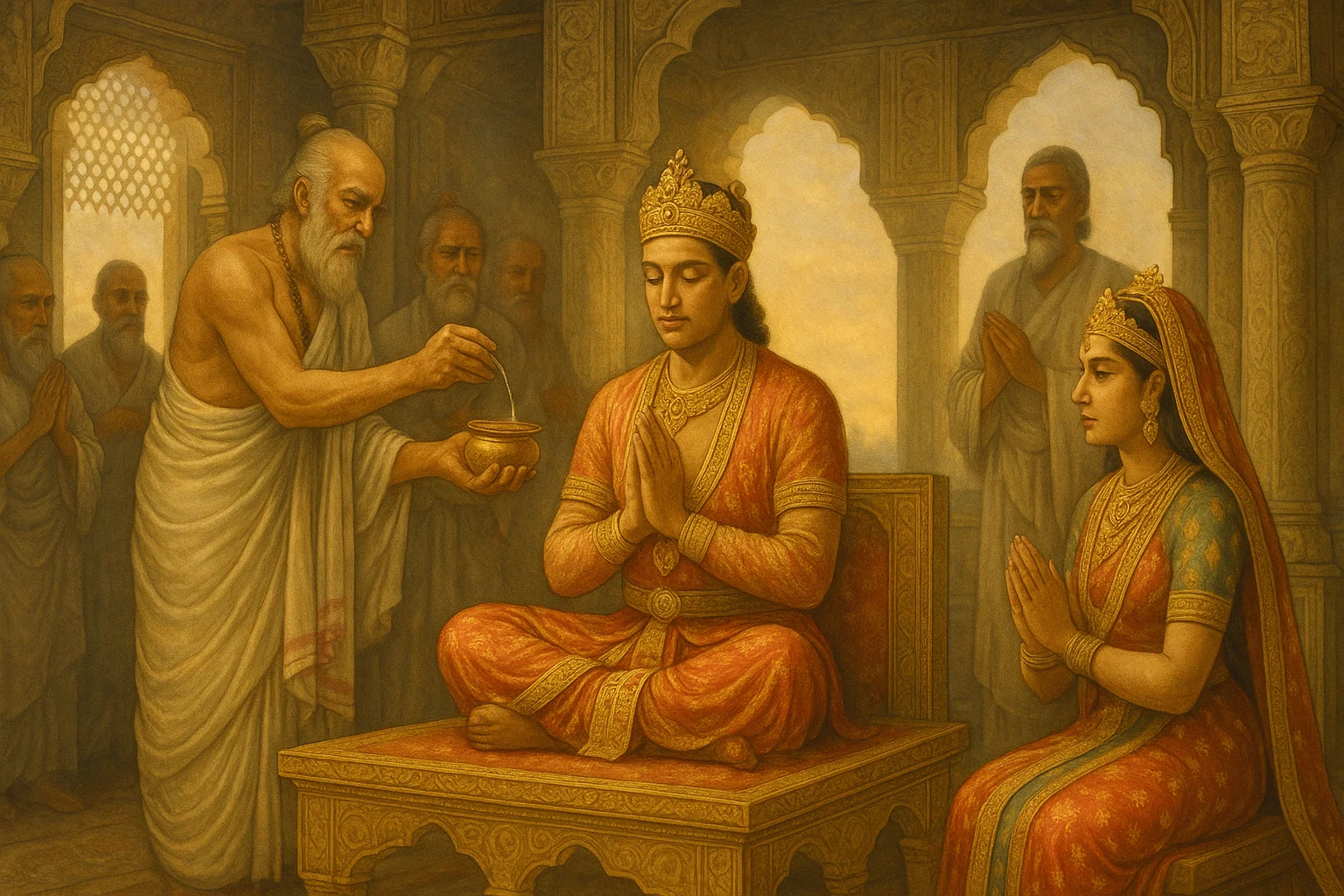
Samudragupta’s legacy is paradoxical. On one hand, he transformed the political landscape of India and initiated what historians recognize as a golden age of Indian civilization. On the other hand, he remains virtually unknown outside academic specialists in ancient Indian history. This paradox demands explanation.
The golden age that Samudragupta initiated continued under his successors, particularly Chandragupta II. The Gupta period saw the composition of literary masterpieces like Kalidasa’s plays and poems, which still rank among the greatest achievements of Sanskrit literature. The period produced advances in mathematics, including contributions to what would become the decimal system and concept of zero. Astronomers made calculations of remarkable precision. Architects and sculptors created works that defined classical Indian aesthetics. All of this creative and intellectual ferment flourished under the political stability and cultural patronage that Samudragupta had established.
The administrative efficiency that characterized the Gupta Empire influenced subsequent Indian political systems. The concept of a paramount sovereign receiving tribute and loyalty from subordinate rulers while allowing them substantial autonomy became a model that later empires would adapt. The use of Sanskrit as an administrative and cultural language helped create a common elite culture across diverse regions. The balance between central authority and local autonomy that Samudragupta achieved demonstrated that empire in India didn’t require brutal uniformity but could accommodate regional diversity within an overarching political structure.
The military reputation that Samudragupta established served the empire long after his death. Potential enemies remembered his campaigns and thought twice before challenging Gupta authority. The systematic way he had categorized and dealt with different types of kingdoms—elimination for dangerous neighbors, vassalage for distant territories, tribute arrangements for frontier regions—demonstrated strategic thinking that influenced how his successors approached expansion and consolidation.
The cultural patronage that Samudragupta championed became a model for legitimate kingship in India. The ideal ruler was not merely a successful warrior but a patron of learning, a protector of dharma, an appreciator of arts, and a performer of sacred rituals. This ideal, embodied in Samudragupta and continued by his successors, would influence Indian political thought for centuries. Kings and emperors who came after measured themselves against this Gupta standard.
What History Forgets
The question remains: why did this emperor who accomplished so much vanish from popular historical memory? Several factors contributed to Samudragupta’s disappearance from mainstream historical consciousness.
First, the sources for his reign, while remarkable, are limited. The Allahabad Pillar inscription provides extensive detail about his military campaigns and achievements, but it’s a single source presenting an official, idealized account. Unlike Alexander, whose campaigns were recorded by multiple contemporary historians and whose story was elaborated by generations of subsequent writers, Samudragupta’s narrative comes to us primarily through the Pillar and his coins. There are no epic accounts of his battles, no detailed chronicles of his court, no collections of his correspondence or speeches. The historical record preserves the outline of his achievements but loses the human details that make figures come alive in popular imagination.
Second, the cultural transmission of historical memory matters. The Gupta Empire was ultimately overrun by the Huna invasions in the sixth century, disrupting the political and cultural continuity that helps preserve historical memory. While Gupta cultural achievements influenced subsequent Indian civilization, the political dynasty itself ended. There were no direct successors to champion Samudragupta’s memory the way Byzantine emperors preserved and elaborated Roman imperial history, or the way European monarchies maintained Alexander’s legend.
Third, the nature of Sanskrit historical writing differs from Greek and Roman historiography. Indian classical literature emphasized religious texts, poetry, and philosophical works over systematic historical chronicles. The great literary works of the Gupta period are dramas and poems, not histories. Information about political events often appears embedded in inscriptions, coins, and incidental references in literary works rather than in dedicated historical narratives. This literary culture, while producing magnificent achievements, did not prioritize the kind of detailed historical record-keeping that preserved Alexander’s story.
Fourth, colonial historiography played a role. When British scholars began systematic study of Indian history in the nineteenth century, they brought assumptions shaped by their own cultural traditions. The narrative of Indian history they constructed emphasized periods and figures that fit familiar patterns—Muslim invasions, Mughal splendor, and finally British conquest. The ancient and medieval Hindu kingdoms received less attention. While scholarly work on the Gupta period was certainly conducted, it didn’t enter popular consciousness in India or abroad the way stories of European conquerors did.
Fifth, the nature of Samudragupta’s achievements made them less dramatic for popular storytelling. He didn’t cross impossible barriers like Alexander’s Hindu Kush or Hannibal’s Alps. He didn’t confront familiar enemies like Caesar’s Gauls or Napoleon’s European coalitions. He conquered kingdoms whose names mean nothing to modern audiences—names preserved only in the Allahabad Pillar inscription, names of places whose locations are still debated by scholars. The geography of his campaigns, while vast, was confined to the Indian subcontinent rather than spanning multiple continents in the way that Alexander’s or Roman conquests did.
Yet none of these explanations fully justify the obscurity into which Samudragupta has fallen. His military achievements rival those of any ancient conqueror. His administrative sophistication exceeded that of most empire-builders. His cultural legacy shaped Indian civilization for centuries. The combination of warrior prowess and intellectual patronage that he embodied was extraordinary even by the standards of great historical figures. He deserves to be remembered alongside Alexander, Augustus, and Akbar as one of history’s great empire-builders—yet outside specialized academic circles, his name draws blank stares.
The coins showing him playing the veena offer perhaps the most poignant symbol of what history has forgotten. Here was a man who conquered much of India, transformed a kingdom into an empire, initiated a golden age of culture and learning, and still found time to master the classical Indian stringed instrument. The image captures the ideal of the complete ruler—warrior and scholar, conqueror and patron, powerful and refined. It speaks to an aspiration toward excellence across multiple domains that deserves to be remembered.
The Allahabad Pillar still stands, its inscription still listing Samudragupta’s conquests. The coins still circulate in museums and collections. The scholarly studies continue to be written. The evidence of his greatness survives for anyone willing to look. But evidence is not memory, and without memory, even the greatest achievements fade into obscurity. Samudragupta deserves better than this oblivion. He deserves to be remembered not just as a footnote in ancient Indian history but as one of the great figures in world history—a military genius, an effective administrator, a cultural patron, and an emperor who transformed his world. India’s Napoleon deserves to be as famous as France’s.