Overview
Taxila, historically known as Takshashila, stands as one of the most significant archaeological and educational sites in South Asian history. Founded around 1000 BCE on the Pothohar Plateau in present-day Punjab, Pakistan, this ancient city flourished for over fifteen centuries as a major center of learning, Buddhism, and cross-cultural exchange. Its strategic location approximately 25 kilometers northwest of modern Islamabad-Rawalpindi placed it at the crossroads of major trade routes connecting Central Asia with the Indian subcontinent.
The city's importance transcended mere geography. Taxila emerged as one of the world's earliest centers of higher learning, where students from across Asia gathered to study diverse subjects ranging from medicine and astronomy to military science and philosophy. The ancient university at Taxila predated European institutions like Oxford and Cambridge by more than a millennium, establishing educational traditions that would influence the development of learning centers throughout Asia.
As a UNESCO World Heritage Site designated in 1980, Taxila preserves invaluable evidence of the Gandharan civilization, where Greek, Persian, Central Asian, and Indian cultures merged to create unique artistic and architectural traditions. The ruins of its three major settlements - Bhir Mound, Sirkap, and Sirsukh - along with numerous Buddhist monasteries and stupas, offer unparalleled insights into ancient urban planning, religious architecture, and the evolution of Buddhist art.
Etymology and Names
The name "Taxila" derives from the ancient Sanskrit name "Takshashila," which translates to "City of Cut Stone" (taksha meaning "to cut" or "carpenter" and shila meaning "stone"). This etymology reflects the city's reputation for stone craftsmanship and architecture. According to Indian tradition and texts like the Ramayana, the city was named after Taksha, the son of Bharata (brother of Rama), who was said to have founded the city.
The name underwent various transformations as different cultures encountered the city. Greek and Roman writers, including those accompanying Alexander the Great's campaigns, rendered the name as "Taxila" or "Taxilla," which has become the standard modern English spelling. In ancient Buddhist texts written in Pali, the city appears as "Takkasila," while Chinese Buddhist pilgrims who visited the site referred to it as "Ta-ch'a-shi-lo" or similar phonetic variants.
Throughout its long history under different ruling powers - from the Achaemenid Persians to the Mauryas, Indo-Greeks, Indo-Scythians, and Kushans - the city maintained variations of its original name, demonstrating remarkable continuity of identity despite changing political control. This linguistic persistence underscores Taxila's enduring cultural and religious significance across multiple civilizations.
Geography and Location
Taxila occupies a strategic position on the Pothohar Plateau of Punjab, at an elevation of approximately 549 meters (1,801 feet) above sea level. The Pothohar Plateau is characterized by undulating terrain, with rocky outcrops and fertile valleys that provided both defensive advantages and agricultural potential for ancient settlements. The region experiences a semi-arid climate with hot summers and relatively mild winters, conditions that proved conducive to sustained human habitation since prehistoric times.
The city's location proved strategically invaluable for multiple reasons. It sat at a crucial junction where routes from Central Asia and Afghanistan met paths leading into the Indian subcontinent. The ancient Grand Trunk Road, one of Asia's oldest and longest major roads, passed through or near Taxila, connecting it with territories stretching from Bengal in the east to Kabul in the west. This positioning made Taxila a natural stopping point for merchants, pilgrims, scholars, and armies traversing the region.
The geographical setting of Taxila within the broader Gandhara region placed it in a natural corridor between mountain ranges and river systems. To the north lay the formidable Hindu Kush and Himalayan mountain ranges, while to the south stretched the fertile plains of Punjab. This intermediate position allowed Taxila to serve as both a defensive frontier for Indian kingdoms and an entry point for influences and peoples from Central Asia, Persia, and beyond.
The availability of water resources, including streams and the proximity to larger river systems, supported agriculture and urban development. Stone quarries in the surrounding hills provided building materials, while forests offered timber. This combination of strategic location, defensive terrain, agricultural potential, and natural resources explains why successive civilizations chose to establish and maintain major settlements at Taxila for over fifteen hundred years.
Ancient History
Archaeological evidence suggests that the Taxila region has been inhabited since the Neolithic period, with the earliest substantial settlement at Bhir Mound dating to approximately 1000 BCE. This makes Taxila one of the oldest continuously inhabited urban areas in South Asia. The initial settlement likely began as a small agricultural community that gradually expanded due to its favorable location on emerging trade routes.
By the 6th century BCE, Taxila had developed into a significant urban center and became part of the Achaemenid Persian Empire under Darius I (522-486 BCE). Persian control brought Taxila into contact with a vast imperial network stretching from Egypt to Central Asia, introducing new administrative systems, artistic motifs, and cultural practices. The Achaemenid period established Taxila as an important provincial center, a status it would maintain under successive empires.
The city figures prominently in ancient Indian literature and tradition. Buddhist Jataka tales mention Taxila as a great center of learning where princes and brahmins traveled to complete their education. The Ramayana connects the city's founding to the legendary prince Taksha. These literary references, while containing mythological elements, reflect Taxila's genuine reputation as an ancient seat of learning and culture.
The turning point in Taxila's documented history came with Alexander the Great's invasion in 326 BCE. According to classical sources, the ruler of Taxila, King Ambhi (also called Omphis by Greek historians), chose to submit to Alexander rather than resist. This decision spared the city from destruction and briefly brought it into direct contact with Hellenistic civilization, an encounter that would profoundly influence the region's subsequent artistic and cultural development.
Historical Timeline
Mauryan Period (326-185 BCE)
Following Alexander's death and the fragmentation of his empire, Taxila came under the control of Chandragupta Maurya, founder of the Mauryan Empire. The Mauryan period marked a golden age for Taxila as a center of Buddhism and learning. According to tradition, the great political strategist and philosopher Chanakya (also known as Kautilya), author of the Arthashastra, was associated with Taxila, possibly teaching or studying there before becoming the advisor to Chandragupta Maurya.
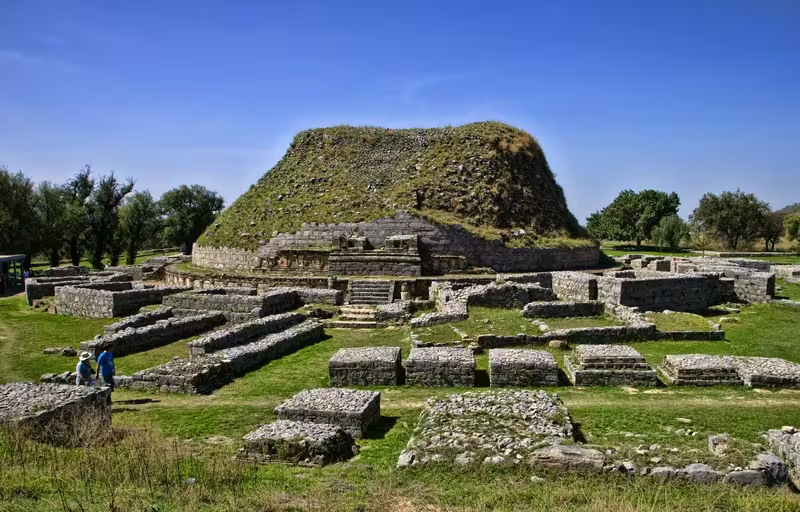
The most significant Mauryan development at Taxila occurred during the reign of Emperor Ashoka (268-232 BCE). After his conversion to Buddhism following the bloody Kalinga War, Ashoka established Buddhist monuments throughout his empire, including at Taxila. The Dharmarajika stupa, one of Taxila's most important monuments, is traditionally believed to have been built during Ashoka's reign to house relics of the Buddha. This period saw Taxila firmly established as a major Buddhist pilgrimage site and center of Buddhist learning.
Indo-Greek and Indo-Scythian Period (185 BCE - 30 CE)
The collapse of the Mauryan Empire around 185 BCE ushered in a period of Indo-Greek rule. Greco-Bactrian kings, descendants of Alexander's generals who had established kingdoms in Central Asia, gradually extended their control into northern India. Under Indo-Greek rule, Taxila witnessed the beginning of the distinctive Gandharan artistic style, which blended Greek sculptural techniques with Indian Buddhist subjects.
Around this time, the city of Sirkap was founded adjacent to the earlier settlement at Bhir Mound. Sirkap displayed clear Hellenistic influence in its gridded street plan, a marked contrast to the organic layout of earlier Indian cities. The Double-Headed Eagle stupa at Sirkap, with its Greco-Buddhist sculptural elements, exemplifies the cultural synthesis occurring during this period.
The Indo-Greek period was followed by rule under Indo-Scythian (Saka) and then Indo-Parthian dynasties, each leaving their mark on the city's cultural and architectural landscape while maintaining Taxila's status as an important Buddhist center.
Kushan Period (30-375 CE)
The Kushan Empire, established by nomadic peoples from Central Asia, presided over Taxila's final and arguably most brilliant flowering. The Kushan period saw the full maturation of Gandharan art, with numerous monasteries, stupas, and sculptures created in the distinctive style that depicted the Buddha and bodhisattvas in human form, often with Greco-Roman stylistic features.
Kushan emperors, particularly Kanishka I (c. 127-150 CE), were great patrons of Buddhism. During this period, Taxila attracted Buddhist monks and scholars from across Asia. Chinese pilgrims' accounts, though written centuries later, describe Taxila during its Kushan heyday as containing numerous monasteries housing thousands of monks.
The city of Sirsukh, the third and final major settlement at Taxila, was founded during the late Kushan or early post-Kushan period. Its massive fortification walls, built in the characteristic Kushan style, reflect both the prosperity of the period and growing security concerns as Central Asian stability began to erode.
Decline (375-500 CE)
Taxila's decline began with the invasion of the Hephthalites (White Huns) in the late 5th century CE. These Central Asian nomadic peoples devastated much of northern India and Afghanistan. According to Chinese pilgrim Xuanzang, who visited the region in the 7th century CE, Taxila lay in ruins, its monasteries destroyed, and its scholarly community dispersed. While some settlement continued, the city never recovered its former glory as a center of learning and Buddhism.
The reasons for Taxila's irreversible decline were multiple: the Hephthalite invasions physically destroyed much of the city's infrastructure, shifting trade routes reduced its commercial importance, and the gradual decline of Buddhism in the Indian subcontinent (partly due to the revival of Hinduism and later the arrival of Islam) removed the religious motivation that had drawn scholars and pilgrims to the city.
Political Significance
Throughout its history, Taxila served as a crucial political prize and administrative center for successive empires. Its position as a gateway between the Indian subcontinent and Central Asia made control of Taxila essential for any power seeking to dominate northern India or expand westward from India into Afghanistan and beyond.
Under the Achaemenid Persians, Taxila functioned as a provincial capital, collecting tribute and serving as a base for imperial administration. The city's political importance continued under the Mauryan Empire, where it served as a major administrative center for the empire's northwestern territories. Ashoka's rock edicts found in the region were written in Aramaic and Greek in addition to Prakrit, reflecting the cosmopolitan nature of the area's administration and population.
During the Indo-Greek period, Taxila served various Greco-Bactrian kings as a capital or major provincial center, representing the easternmost extent of Hellenistic political control. The city's ability to maintain its prosperity and importance under rapidly changing political control demonstrates both its strategic value and the sophistication of its urban institutions.
Religious and Cultural Importance
Taxila's greatest historical significance lies in its role as a Buddhist center and seat of learning. From the Mauryan period onwards, the city became one of the most important pilgrimage sites in the Buddhist world. The Dharmarajika stupa, along with dozens of other monasteries and stupas in the Taxila valley, attracted monks and devotees from across Asia.
The city's monasteries functioned not just as religious centers but as vibrant intellectual communities. Scholars studied Buddhist philosophy, Sanskrit and Pali texts, logic, and metaphysics. The system of education at Taxila, as described in Buddhist Jataka tales and later accounts, involved students living with teachers in a guru-shishya (teacher-student) relationship, studying a comprehensive curriculum that included the Vedas, grammar, philosophy, astronomy, medicine, and military science.
Taxila's cultural significance extended beyond Buddhism. As a crossroads of civilizations, the city witnessed the meeting and mingling of Indian, Persian, Greek, and Central Asian cultures. This cultural synthesis found its most visible expression in Gandharan art, which emerged in and around Taxila during the Indo-Greek and Kushan periods. Gandharan sculpture, with its distinctive blend of Greek sculptural realism and Indian Buddhist iconography, represents one of the most important artistic movements in Asian history and was the first tradition to depict the Buddha in human form.
Economic Role
Taxila's prosperity derived largely from its position on major trade routes. The city sat astride what would later become known as the Grand Trunk Road and was also connected to the Silk Route network that linked China with the Mediterranean world. Merchants passing through Taxila traded goods ranging from Chinese silk and Central Asian horses to Indian spices and textiles.
Archaeological excavations have revealed evidence of numerous craft specializations in ancient Taxila, including metalworking (particularly in copper and bronze), jewelry making, pottery, and stone carving. The city's craftsmen achieved particular renown for their work in stone, which aligns with the etymology of the city's name. The production of Gandharan sculpture and architectural elements represented a significant economic activity, with demand coming from Buddhist patrons across Asia.
The presence of coins from various periods - Achaemenid, Greek, Mauryan, Indo-Greek, Kushan - indicates sustained commercial activity and Taxila's integration into wider economic networks. Coins minted at Taxila itself have been found across northern India and Central Asia, demonstrating the city's role in monetary circulation and trade.
Monuments and Architecture
The archaeological remains at Taxila comprise multiple sites spanning different periods, providing a comprehensive picture of urban evolution over fifteen centuries. The three main settlement sites - Bhir Mound, Sirkap, and Sirsukh - each represent different phases of the city's development.
Bhir Mound, the earliest settlement (c. 1000-200 BCE), displays an organic, irregular street pattern typical of pre-Greek urban planning in India. The remains include fortification walls, residential areas, and evidence of commercial activities.
Sirkap (c. 200 BCE - 200 CE) showcases clear Hellenistic influence with its regular grid pattern, wide main streets, and planned layout. The city walls, stretching approximately 5 kilometers, enclosed an area containing royal palaces, residential blocks, temples, and stupas. The Double-Headed Eagle stupa at Sirkap, decorated with reliefs showing Greek and Persian motifs alongside Indian symbols, exemplifies the syncretic character of Gandharan art.
Sirsukh (c. 200-500 CE), the last major settlement, was enclosed by massive stone walls characteristic of Kushan military architecture. Though less extensively excavated than Sirkap, Sirsukh represents the final phase of urban development before the city's abandonment.
Beyond the main urban settlements, the Taxila valley contains numerous Buddhist monasteries (viharas) and stupas. The Dharmarajika stupa complex, traditionally associated with Emperor Ashoka, comprises a central stupa surrounded by smaller votive stupas and monastic buildings. Archaeological excavations have revealed elaborate foundations, relic chambers, and numerous sculptures in the Gandharan style.
The Jaulian monastery and stupa, dating to the Kushan period, features well-preserved stucco sculptures and architectural details. The monastery includes meditation cells, a courtyard, and a stupa decorated with numerous Buddha and bodhisattva images. Similarly, the Mohra Muradu monastery showcases the typical layout of Buddhist monastic establishments in the Gandhara region.
Excavation and Archaeological Research
Systematic archaeological investigation of Taxila began under Sir Alexander Cunningham in the 1860s, as part of the Archaeological Survey of India's efforts to document ancient sites. However, the most extensive excavations were conducted by Sir John Marshall between 1913 and 1934. Marshall's work uncovered the three main cities, dozens of monasteries and stupas, and thousands of artifacts that illuminated the history of the Gandharan civilization.
Marshall's excavations revealed the stratigraphic sequence of occupation at Taxila, documenting the transition from Achaemenid through Greek to Kushan rule. His discovery of coins, sculptures, inscriptions, and everyday artifacts allowed for detailed reconstruction of economic, religious, and cultural life. The methodical nature of Marshall's excavations, while conducted according to early 20th-century standards, established Taxila as one of the most comprehensively studied ancient sites in South Asia.
Subsequent archaeological work, including excavations by Pakistani archaeologists after independence, has continued to refine our understanding of Taxila's history. Modern archaeological techniques, including radiocarbon dating and architectural analysis, have provided more precise chronologies and insights into construction methods.
Famous Personalities
Ancient tradition associates several notable figures with Taxila, though separating historical fact from legend proves challenging. Chanakya (Kautilya), the ancient Indian political strategist and author of the Arthashastra, is traditionally linked with Taxila as either a student or teacher at its university. While the historical accuracy of these accounts remains debated, they reflect Taxila's reputation as a premier center of learning in ancient India.
The Jataka tales, stories of the Buddha's previous lives, mention several scholars and princes who studied at Taxila, including the physician Jivaka, who supposedly learned medicine there before becoming the Buddha's personal physician. While these accounts are religious literature rather than historical documents, they indicate Taxila's fame as an educational center in the Buddhist world.
Chinese pilgrims including Faxian (5th century CE) and Xuanzang (7th century CE) visited or described Taxila in their accounts, though by their time the city had declined significantly. Xuanzang's description of the ruins of Taxila provides valuable information about the city's former glory and the circumstances of its decline.
Decline and Abandonment
The decline of Taxila represents one of the most significant urban abandonments in South Asian history. Multiple factors contributed to the city's fall from prominence and eventual desertion by the 6th century CE.
The Hephthalite invasions of the late 5th century CE dealt the most devastating blow. These Central Asian nomadic peoples, known to Indian sources as Hunas, swept through Afghanistan and northern India, destroying Buddhist monasteries and urban centers. Xuanzang's 7th-century account describes finding Taxila in ruins, its monasteries destroyed, and its scholarly community scattered.
Economic factors also played a role. As political instability increased in Central Asia and new trade routes emerged, Taxila's commercial importance diminished. The city's prosperity had always depended on its position as a waystation on major trade routes; when these routes shifted or became unsafe, Taxila's economic foundation eroded.
The decline of Buddhism in the Indian subcontinent removed another pillar of Taxila's importance. As Hindu practices experienced revival and later as Islam spread into the region, the network of Buddhist pilgrimage and learning that had sustained Taxila's monasteries weakened. Without the constant flow of Buddhist monks, students, and patrons, the city's primary reason for existence disappeared.
Environmental changes may have contributed as well. Some scholars suggest that deforestation, soil erosion, or changes in water availability made the site less suitable for sustained urban occupation, though this remains a subject of ongoing research.
By the medieval period, Taxila had been abandoned as an urban center. Unlike many ancient cities that evolved into modern settlements, Taxila was left as ruins, preserving its archaeological remains but losing continuity with its illustrious past.
Modern Status and Heritage Conservation
Today, Taxila exists as both a modern town of approximately 136,900 people (2017 estimate) and a complex of archaeological sites preserving the remains of the ancient city. The modern town developed separately from the archaeological sites, which has helped preserve the ancient remains but also creates management challenges.
UNESCO World Heritage designation in 1980 recognized Taxila's outstanding universal value. The World Heritage site encompasses multiple archaeological zones spread across the Taxila valley, including the three main cities (Bhir Mound, Sirkap, and Sirsukh) and numerous Buddhist monasteries and stupas. The designation has brought international attention and resources for conservation, though also challenges related to site management and tourism development.
The Taxila Museum, established in 1928, houses one of the world's finest collections of Gandharan art and artifacts from the excavations. The museum's collections include sculptures, coins, pottery, jewelry, and everyday objects that illuminate ancient life at Taxila. The museum serves as an essential complement to visiting the archaeological sites, helping visitors understand the artifacts in their original context.
Conservation challenges facing Taxila include weathering of exposed structures, encroachment from the expanding modern town, inadequate site infrastructure, and limited resources for ongoing maintenance and research. Climate change and increased rainfall patterns pose growing threats to the ancient structures. Pakistani authorities, working with UNESCO and international conservation organizations, have implemented various measures to address these challenges, though resource constraints remain a significant issue.
Tourism and accessibility have improved considerably in recent decades. Taxila's proximity to Islamabad and Rawalpindi (approximately 25 kilometers northwest of the twin cities) makes it easily accessible. The site receives visitors from around the world, including Buddhist pilgrims from East and Southeast Asia who regard Taxila as a sacred site. However, tourism infrastructure remains modest compared to similar sites in other countries, presenting both challenges and opportunities for sustainable heritage management.
Legacy and Significance
Taxila's legacy extends far beyond its physical ruins. As one of the earliest centers of higher learning in human history, Taxila established educational traditions and methodologies that influenced the development of universities throughout Asia. The model of residential education, with students living with teachers in a comprehensive learning environment, anticipated aspects of modern university education.
In the realm of art history, Taxila's role in the development of Gandharan art cannot be overstated. The Gandharan style, which first depicted the Buddha in human form and synthesized Greek sculptural techniques with Indian Buddhist iconography, profoundly influenced Buddhist art throughout Asia. Images of the Buddha from Korea to Java trace their artistic lineage back to the innovations that occurred in Taxila and surrounding Gandharan cities.
For the history of Buddhism, Taxila represents one of the most important centers for the faith's development and spread. The monasteries at Taxila served as training grounds for monks who carried Buddhism along the Silk Route to Central Asia, China, and beyond. The city's role in preserving and transmitting Buddhist teachings contributed significantly to Buddhism's transformation from an Indian religion to a pan-Asian faith.
In contemporary times, Taxila serves as a symbol of South Asia's rich cultural heritage and its historical role as a bridge between civilizations. The site demonstrates how cultural exchange and synthesis can produce remarkable artistic and intellectual achievements. For Pakistan, Taxila represents one of the nation's most important heritage assets and a connection to the pre-Islamic civilizations that flourished in the region.