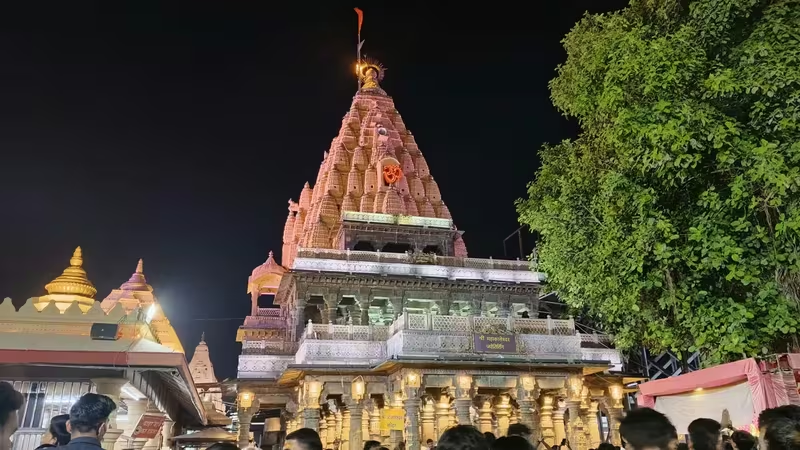
Overview
Ujjain, known in ancient times as Ujjayini or Avantika, stands as one of India's most historically significant and continuously inhabited cities. Located in the Malwa region of Madhya Pradesh, this sacred city has witnessed over 2,700 years of unbroken urban civilization, dating back to approximately 700 BCE. As one of the seven Sapta Puri (sacred cities) of Hinduism, Ujjain holds immense religious importance, being home to the Mahakaleshwar Jyotirlinga—one of the twelve most sacred shrines of Lord Shiva—and hosting the magnificent Simhastha Kumbh Mela every twelve years.
Beyond its spiritual significance, Ujjain has played a pivotal role in India's political, economic, and cultural development. As the ancient capital of the Avanti Mahajanapada, it was one of the sixteen great kingdoms of early India and remained a prominent trade and political center through successive empires—from the Mauryas and Guptas to the medieval sultanates and eventually British colonial rule. The city's strategic location in the fertile Malwa plateau and its position on important trade routes made it a coveted prize for rulers throughout history.
Today, Ujjain serves as the fifth-largest city in Madhya Pradesh and continues to be a major pilgrimage destination, attracting millions of devotees annually. The city seamlessly blends its ancient heritage with modern urban development, maintaining its role as both an administrative center and a living repository of India's spiritual and cultural traditions.
Etymology and Names
The name "Ujjain" derives from the Sanskrit "Ujjayini," which translates to "she who conquers with pride" or "victorious." This name reflects the city's historical importance as a powerful political and military center. In ancient texts and inscriptions, the city appears under several names, each marking different periods of its long history.
The earliest references to the city use the name "Avantika" or "Avanti," which was also the name of the Mahajanapada (great kingdom) of which it was the capital. Vedic literature mentions Avanti as one of the important regions of ancient India. The name Ujjayini gained prominence during the Mauryan period and became the standard designation in classical Sanskrit literature.
Throughout its history, the city has been referred to by various epithets in religious and literary texts, including "Pratikalpa" (a place of auspicious beginnings), "Kumudvati" (city of lotuses), and "Amaravati" (city of immortals). These poetic names reflect the city's sacred status and cultural importance. The modern Hindi name "Ujjain" is a natural phonetic evolution from the Sanskrit "Ujjayini," maintaining continuity with its ancient heritage.
Geography and Location
Ujjain is situated in the Malwa plateau region of western Madhya Pradesh at coordinates 23.1765°N, 75.7885°E, at an elevation of approximately 494 meters (1,621 feet) above sea level. The city's location in the heart of the Indian subcontinent has been strategically significant throughout history, positioned at the intersection of important trade and communication routes connecting northern, western, and southern India.
The sacred Shipra River (also known as Kshipra) flows through the city, playing a central role in Ujjain's religious significance. The river's ghats (stepped embankments) serve as sites for ritual bathing and religious ceremonies, particularly during the Simhastha Kumbh Mela. The Ram Ghat is the most prominent among these, where millions of pilgrims gather during the festival.
Ujjain experiences a humid subtropical climate (Köppen classification Cwa) with three distinct seasons. Summers (March to June) are hot, with average temperatures around 31°C (88°F), while winters (November to February) are mild and pleasant, averaging 17°C (63°F). The monsoon season (July to September) brings the majority of the city's approximately 900 millimeters (35 inches) of annual rainfall. The overall average annual temperature is 24°C (75.2°F).
The Malwa plateau's fertile black soil and relatively flat terrain made the region ideal for agriculture and settlement, contributing to Ujjain's prosperity throughout history. The city's central location also made it a natural choice for astronomical observations, and ancient Indian astronomers designated Ujjain as the prime meridian—the zero-degree longitude—for their geographical and astronomical calculations.
Ancient History
Archaeological evidence suggests that the site of Ujjain has been inhabited since prehistoric times, with urbanization beginning around 700 BCE. The city emerged as a major center during the period of the sixteen Mahajanapadas (great kingdoms) that dominated the Indian subcontinent from approximately 600 to 345 BCE. Ujjain served as the capital of Avanti, one of the most powerful of these kingdoms.
The Avanti Mahajanapada was divided into two parts: northern Avanti with its capital at Ujjayini, and southern Avanti with its capital at Mahishmati (modern Maheshwar). Under dynamic rulers, Avanti became a formidable power, engaging in conflicts with neighboring kingdoms including Magadha, Vatsa, and Kosala. Ancient Buddhist texts mention that Avanti was one of the four great powers of the time, along with Vatsa, Kosala, and Magadha.
Hindu mythology and Puranic literature associate Ujjain with several legendary events and figures. According to tradition, Lord Shiva manifested here as Mahakal (the Great Time or Great Death), vanquishing the demon Dusana and establishing his eternal presence as the Mahakaleshwar Jyotirlinga. The city is also mentioned in the Mahabharata and other ancient epics, indicating its importance in the cultural memory of ancient India.
The city's strategic location and prosperity made it a center of learning and culture even in ancient times. Buddhist sources indicate that Buddhism flourished here during and after the Buddha's lifetime, and the city became an important center for Buddhist learning and practice. The famous Buddhist scholar Mahakaccana, one of the Buddha's principal disciples, was born in Ujjain.
Historical Timeline
Mahajanapada and Mauryan Period
During the Mahajanapada era (c. 700-320 BCE), Ujjain reached its first peak of power and prosperity as the capital of Avanti. The kingdom engaged in extensive trade, both within India and with foreign lands, establishing Ujjain as a major commercial hub. The city's wealth and strategic importance made it a prize in the power struggles that characterized this period of Indian history.
The Avanti kingdom eventually fell to the expanding Magadhan Empire under Shishunaga in the 4th century BCE. Later, when Chandragupta Maurya established the Maurya Empire (322-185 BCE), Ujjain became an important provincial capital. Emperor Ashoka the Great, before ascending to the throne, served as the viceroy of Ujjain, and it was here that he married Devi, a merchant's daughter from Vidisha. This connection made Ujjain one of the most significant cities in the Mauryan Empire after Pataliputra, the imperial capital.
Shunga and Satavahana Period
After the fall of the Mauryas, Ujjain came under the control of the Shunga dynasty (185-73 BCE) and later the Satavahanas. During this period, the city maintained its importance as a trade center and cultural hub. The continued prosperity of the region is evidenced by archaeological findings and references in contemporary literature.
Golden Age under the Guptas
The Gupta period (320-550 CE) marked another golden age for Ujjain. The city flourished as a center of art, literature, and science. This was the era when the legendary poet and playwright Kalidasa is believed to have lived and worked, possibly at the court of Chandragupta II. Kalidasa's masterpiece "Meghaduta" (Cloud Messenger) contains beautiful descriptions of Ujjain, celebrating its beauty, prosperity, and cultural sophistication.
Ujjain's role as an astronomical center reached its zenith during the Gupta period. The city was chosen as the prime meridian (zero longitude) for Indian astronomical calculations, a designation mentioned in major astronomical works including Aryabhata's "Aryabhatiya" and Varahamihira's "Brihat Samhita." The famous Jantar Mantar observatory was later built in the 18th century, continuing this astronomical tradition.
Medieval Period
Following the decline of the Guptas, Ujjain passed through the hands of various dynasties including the Pratiharas, Paramaras, and the Delhi Sultanate. Under Paramara rule (9th-13th centuries), particularly under Raja Bhoja, the city experienced another period of cultural florescence. The Paramaras were patrons of Sanskrit learning and arts, and Ujjain remained an important cultural center.
The establishment of Islamic rule in the region brought new influences to the city. The Delhi Sultanate and later the Malwa Sultanate controlled the region, and Ujjain adapted to these political changes while maintaining its religious and cultural identity. The city's resilience during this period demonstrates its deep-rooted significance in Indian civilization.
Mughal and Maratha Period
During Mughal rule, Ujjain remained an important provincial center. The Mughals, known for their religious tolerance and appreciation of India's diverse heritage, allowed the city to maintain its Hindu religious character. Several temples were renovated or rebuilt during this period, and the city continued to attract pilgrims.
In the 18th century, as Mughal power declined, the Marathas, particularly the Scindias of Gwalior, gained control of the region. Under Maratha patronage, many temples were renovated, and the city experienced a revival of Hindu religious and cultural activities. The Marathas recognized Ujjain's sacred status and provided substantial support for religious institutions.
Colonial Era
The British gradually extended their influence over the region through treaties with the Maratha rulers in the early 19th century. Ujjain became part of the princely state of Gwalior under British paramountcy. During the colonial period, the city's administrative functions continued, and new infrastructure including railways was developed, connecting Ujjain more effectively with other parts of India.
Despite colonial rule, Ujjain maintained its religious and cultural significance. The British period saw the documentation of the city's monuments and history by colonial scholars and archaeologists, preserving valuable records of its heritage.
Post-Independence
After India's independence in 1947, Ujjain became part of the state of Madhya Pradesh. The city has since developed as a major urban center while preserving its religious character. Modern infrastructure, educational institutions, and industries have been established alongside ancient temples and traditional practices. The city continues to serve as the administrative headquarters of Ujjain district and Ujjain division.
Political Significance
Throughout its long history, Ujjain has been a center of political power and administration. As the capital of the Avanti Mahajanapada, it was one of the sixteen great cities that dominated ancient India's political landscape. The city's strategic location in the Malwa plateau made it essential for controlling trade routes and maintaining political influence over central India.
During the Mauryan Empire, Ujjain's importance as a provincial capital was second only to Pataliputra. The posting of Crown Prince Ashoka as viceroy of Ujjain demonstrates the city's administrative significance. From Ujjain, the Mauryan administration managed the western provinces and trade with western India and beyond.
The city's political importance continued through successive dynasties. Under the Guptas, Ujjain served as a major administrative center, and its officials played crucial roles in imperial governance. Medieval rulers recognized that controlling Ujjain meant controlling the prosperous Malwa region and its lucrative trade networks.
Today, Ujjain remains politically significant as the headquarters of Ujjain district and division. The city is administered by the Ujjain Municipal Corporation, which manages 54 wards. It is represented in the Lok Sabha (Indian Parliament) and plays an important role in the politics of Madhya Pradesh.
Religious and Cultural Importance
Ujjain's religious significance is unparalleled in Hindu tradition. As one of the seven Sapta Puri (sacred cities) where moksha (liberation) can be attained, it ranks alongside Ayodhya, Mathura, Haridwar, Varanasi, Kanchipuram, and Dwarka. This sacred status has made the city a perpetual pilgrimage destination for millions of Hindus throughout history.
The Mahakaleshwar Temple, housing one of the twelve Jyotirlingas (sacred self-manifested lingams of Shiva), stands at the heart of the city's religious life. Unlike other Jyotirlingas, the Mahakaleshwar lingam is said to be "Swayambhu" (self-manifested) and faces south—the direction associated with death—making Lord Shiva the deity who conquers death itself. The temple's unique Bhasma Aarti (ritual worship with sacred ash) performed at dawn is a powerful spiritual experience that draws devotees from across India.
Every twelve years, Ujjain hosts the Simhastha Kumbh Mela when Jupiter enters Leo and the Sun enters Aries. During this month-long festival, millions of pilgrims converge on the banks of the Shipra River for ritual bathing, believed to cleanse sins and bestow spiritual merit. The ghats of Ujjain, particularly Ram Ghat, become stages for one of the world's largest religious gatherings, rivaling the Kumbh Melas at Haridwar, Prayagraj, and Nashik.
Beyond the Mahakaleshwar Temple, Ujjain is home to numerous other sacred sites including the Harsiddhi Temple (one of the Shakti Peethas), Kal Bhairav Temple, Mangalnath Temple, and the Sandipani Ashram, where Lord Krishna is said to have received his education. The city's spiritual landscape is rich with temples, ashrams, and sacred spaces that have accumulated over millennia.
Culturally, Ujjain has been a cradle of Sanskrit literature and learning. The city's association with Kalidasa, often considered the greatest Sanskrit poet and playwright, has made it immortal in Indian literary tradition. His works contain exquisite descriptions of Ujjain's beauty, its courtly culture, and the sophistication of its inhabitants. The city was also home to numerous scholars, philosophers, and artists throughout history, contributing significantly to India's classical cultural heritage.
The city's astronomical legacy is equally impressive. Ancient Indian astronomers chose Ujjain as the reference point for calculating time and geographical coordinates. The Tropic of Cancer passes near the city, and its location was considered ideal for astronomical observations. The Vedanga Jyotisha, one of the oldest Indian astronomical texts, uses Ujjain as its reference meridian. This tradition continued into the modern period with the construction of the Jantar Mantar observatory in the 18th century.
Economic Role
From ancient times, Ujjain's central location made it a natural hub for trade and commerce. As the capital of Avanti, the city controlled important trade routes connecting northern India with the ports of western India, particularly those in Gujarat. This position allowed Ujjain to prosper through the taxation of trade and the accumulation of merchant wealth.
The city was famous for particular crafts and products. Ancient texts mention Ujjain's textiles, particularly fine cotton fabrics, precious stones, and perfumes. The fertile Malwa region surrounding the city produced abundant agricultural products, making Ujjain a major grain market. The city's prosperity attracted merchants from distant lands, and archaeological evidence suggests trade connections with the Roman Empire and Southeast Asia.
During the medieval period, Ujjain maintained its commercial importance despite political upheavals. The city's markets were renowned throughout India, and its merchant communities accumulated substantial wealth. This economic prosperity supported the city's cultural and religious institutions, allowing for the construction and maintenance of temples and other public works.
In the modern era, Ujjain has diversified its economy while maintaining its traditional sectors. Today, the city serves as a major commercial center for the Malwa region. Agriculture and agricultural processing remain important, with the surrounding region producing wheat, soybeans, and other crops. The city has developed industries including textiles, chemicals, and pharmaceuticals. However, the most significant economic driver is religious tourism, with millions of pilgrims visiting annually and generating substantial revenue for the local economy.
The city is well-connected by road and rail, with Ujjain Junction serving as an important railway station on the Western Railway network. This connectivity facilitates both traditional commerce and modern industry, while supporting the continuous flow of pilgrims that sustains much of the city's economy.
Monuments and Architecture
The Mahakaleshwar Temple dominates Ujjain's architectural landscape. The current structure, though rebuilt multiple times, maintains traditional Hindu temple architecture with a tall shikhara (spire) visible from across the city. The temple complex is vast, with multiple shrines, courtyards, and a sacred tank. The sanctum sanctorum houses the Jyotirlinga in a below-ground chamber, a unique feature among the twelve Jyotirlingas. The temple's daily rituals, particularly the Bhasma Aarti, demonstrate the living continuity of ancient worship practices.
The Harsiddhi Temple, another major religious structure, is one of the Shakti Peethas where, according to tradition, a part of the goddess Sati's body fell. The temple features distinctive architecture with its sri yantra carved in stone and towering vermillion-painted pillars. The temple has been renovated multiple times throughout history, with the current structure reflecting both ancient traditions and later additions.
The Ram Ghat along the Shipra River is the architectural and spiritual heart of Ujjain's relationship with its sacred river. The extensive stone steps leading to the water, the numerous small shrines, and the pavilions create a sacred landscape that comes alive during daily rituals and explodes with activity during the Kumbh Mela. The ghat's design facilitates the ritual bathing of thousands of pilgrims simultaneously.
The Jantar Mantar observatory, built by Maharaja Jai Singh II in the 18th century, stands as a monument to Ujjain's astronomical heritage. Part of a series of five such observatories (others located in Delhi, Jaipur, Varanasi, and Mathura), the Ujjain Jantar Mantar contains instruments designed for tracking celestial objects and calculating astronomical positions. Though smaller than its Jaipur counterpart, it represents the continuation of Ujjain's ancient role as India's astronomical center.
The Kal Bhairav Temple, dedicated to the fierce form of Shiva, is notable for its unique ritual practices and folk architecture. The temple is famous for its tradition of offering liquor to the deity, a practice that distinguishes it from most Hindu temples. The structure reflects the synthesis of mainstream Hindu practices with local folk traditions.
The Sandipani Ashram, traditionally identified as the site where Lord Krishna received his education, contains ancient caves and structures believed to date back thousands of years. The site includes the Gomti Kund, a sacred tank where, according to tradition, water from all India's sacred rivers was brought for Krishna's use.
Other notable structures include the Gopal Mandir, built in the 19th century with Maratha architectural influences, and various ghats, temples, and historical buildings that dot the cityscape, each contributing to Ujjain's rich architectural tapestry.
Famous Personalities
Ujjain's long history has been intertwined with numerous notable figures. Emperor Ashoka's connection with the city during his time as viceroy is one of the most significant. It was in Ujjain that Ashoka married Devi and fathered his son Mahendra and daughter Sanghamitta, who later became instrumental in spreading Buddhism to Sri Lanka. Some traditions suggest that Ashoka's transformation toward Buddhism may have begun during his time in Ujjain, influenced by the city's diverse spiritual traditions.
The poet and playwright Kalidasa's association with Ujjain, though not definitively proven, is strongly suggested by his intimate and detailed descriptions of the city in his works. His masterpiece "Meghaduta" paints a vivid picture of Ujjain's beauty, culture, and sophistication, serving as both a literary achievement and a historical document of the city during the Gupta period.
The great astronomer-mathematician Brahmagupta (598-668 CE), author of the Brahmasphutasiddhanta, was connected with Ujjain's astronomical tradition. His work built upon earlier astronomical studies conducted in the city and contributed to Ujjain's reputation as India's astronomical capital.
Chandragupta Vikramaditya, the legendary king whose court is said to have included the "nine jewels" (Navaratna) of scholars and artists, may have ruled from Ujjain. While historical details remain debated, the tradition associates this golden age of Sanskrit literature and arts with Ujjain.
Maharaja Jai Singh II of Jaipur, the 18th-century astronomer-king who built the Jantar Mantar observatories, recognized Ujjain's astronomical importance by including it among the five cities where he constructed these sophisticated instruments.
Numerous saints, scholars, and religious figures have lived in or visited Ujjain throughout history, contributing to its reputation as a center of learning and spirituality. The city's ashrams and temples have been teaching centers for generations of spiritual seekers and scholars.
Modern City
Today, Ujjain is the fifth-largest city in Madhya Pradesh with a municipal population of approximately 515,000 and a metropolitan area population of around 885,000. The city serves as the administrative headquarters of both Ujjain district and the larger Ujjain division, which encompasses several districts in western Madhya Pradesh.
The Ujjain Municipal Corporation, established to manage the growing urban area, oversees 54 wards and provides civic services to residents and the millions of visitors who come to the city annually. The city has developed modern infrastructure while attempting to preserve its historical character, a balancing act common to many ancient Indian cities in the modern era.
Education has become increasingly important in modern Ujjain. The city is home to Vikram University, established in 1957, which serves as a major educational institution for the region. Numerous colleges affiliated with the university offer programs in arts, sciences, commerce, and professional fields. The city also has several schools and technical institutes serving its educational needs.
Healthcare infrastructure has expanded with multiple hospitals and clinics providing medical services to the city's residents and pilgrims. The influx of pilgrims, particularly during major festivals, has necessitated robust public health systems to manage the temporary surge in population.
The city's economy remains centered on religious tourism, but has diversified to include manufacturing, services, and technology sectors. Traditional crafts continue alongside modern industries. The city's markets remain vibrant, offering everything from religious items to modern consumer goods.
Transportation infrastructure has improved significantly in recent decades. Ujjain Junction railway station connects the city to major Indian cities including Delhi, Mumbai, and Indore. Road connectivity has also improved with national highways linking Ujjain to the broader regional and national road network. An airport at Indore, approximately 55 kilometers away, provides the nearest air connectivity.
Despite modernization, Ujjain has maintained its essential character as a pilgrimage city. The rhythm of daily life continues to be marked by temple rituals, and the Shipra River ghats remain central to the city's spiritual identity. The challenge of managing heritage conservation while promoting development remains ongoing, with various projects aimed at preserving historical monuments while improving civic amenities.
The Simhastha Kumbh Mela continues to be the city's most significant event, requiring massive infrastructure preparation every twelve years to accommodate millions of pilgrims. The most recent major Kumbh in 2016 saw extensive development of facilities, demonstrating how this ancient tradition drives modern urban planning and development.
Timeline
See Also
- Varanasi - Another of the seven sacred cities (Sapta Puri)
- Haridwar - Host city of Kumbh Mela and sacred pilgrimage site
- Nashik - Another Kumbh Mela host city
- Pataliputra - Mauryan capital during Ashoka's time