Overview
The Third Anglo-Maratha War (1817-1819) stands as one of the most consequential conflicts in Indian history, marking the definitive end of the Maratha Empire and establishing British supremacy over the Indian subcontinent. Lasting from November 5, 1817, to April 9, 1819, this final confrontation between the British East India Company and the Maratha confederacy resulted in the complete subjugation of the last major indigenous power capable of challenging British colonial expansion.
Led by Governor-General Hastings and supported by General Thomas Hislop, British forces invaded Maratha territory under the pretext of suppressing Pindari raiders—bands of mercenaries and irregular forces that had been destabilizing central India. However, the campaign quickly evolved into a comprehensive conquest of all Maratha territories. Despite being significantly outnumbered, the British forces decimated the Maratha armies through superior coordination, artillery, and military discipline.
The war's outcome fundamentally transformed the political landscape of India. The Peshwa's authority was abolished, ending a lineage that had dominated Maratha politics for over a century. The major Maratha houses—Scindia, Holkar, and Bhonsale—were reduced to subsidiary states under British suzerainty. Only Chhatrapati Pratap Singh retained a semblance of autonomy as the Raja of Satara, though firmly under British control. The conflict left the British East India Company in control of most of India, setting the stage for the formal establishment of the British Raj in the following decades.
Background
The Maratha Confederacy in Decline
By the early 19th century, the once-formidable Maratha Empire had fragmented into a loose confederacy of semi-independent states. The empire that had expanded dramatically under the Peshwas in the 18th century now consisted of competing power centers: the Peshwa at Pune, the Gaekwad of Baroda, the Scindia of Gwalior, the Holkar of Indore, and the Bhonsale of Nagpur. Internal rivalries and the lack of unified command had weakened the confederacy's ability to respond to external threats.
The Second Anglo-Maratha War (1803-1805) had already significantly eroded Maratha power. The Treaty of Bassein (1802), which Peshwa Baji Rao II had signed under duress, had effectively made the Peshwa a British protectorate. This humiliating arrangement had created deep resentment among Maratha leaders and highlighted the empire's declining military capabilities against British forces.
The Pindari Problem
Central India in the early 19th century was plagued by Pindari raids. These bands of irregular cavalry, numbering perhaps 20,000-30,000 men, operated as mercenaries and raiders, pillaging territories across central and southern India. While some Pindaris had historical connections to Maratha armies, they operated largely independently, creating instability that affected both British territories and Maratha lands.
The Pindaris posed a dual problem for the British. Their raids disrupted trade and agriculture in Company territories, creating economic losses and administrative challenges. More strategically, the existence of these irregular forces represented a potential military resource that could be mobilized against British interests. The decision to mount a campaign against the Pindaris provided the British with a convenient pretext for moving large military forces into Maratha territories.
British Strategic Ambitions
Governor-General Lord Hastings (not to be confused with Warren Hastings, an earlier Governor-General) had arrived in India in 1813 with clear strategic objectives. The British East India Company had consolidated its power in Bengal, parts of southern India, and the western coast, but large swathes of central and western India remained under Maratha control or influence. Hastings recognized that eliminating the Maratha confederacy was essential for establishing unchallenged British supremacy over the subcontinent.
The British had several strategic advantages by 1817. Their military forces combined European discipline and tactics with large numbers of trained Indian sepoys. British artillery was superior to anything the Marathas could field. Moreover, the Company had developed sophisticated intelligence networks and diplomatic machinery that could exploit divisions among Indian rulers. The financial resources of the Company, backed by British industrial and commercial power, also gave them staying power that Indian rulers could not match.
Prelude
Military Preparations
Throughout 1817, the British assembled a formidable military force under the guise of anti-Pindari operations. Governor-General Hastings coordinated a multi-pronged strategy that positioned British and Company forces to strike at all major Maratha centers simultaneously. General Thomas Hislop commanded forces in central India, while other commanders were positioned to move against Pune, Nagpur, and other strategic locations.
The British force comprised both European regiments and large contingents of Indian sepoys, particularly from Bengal and Madras. The Company's military organization was far superior to the Maratha armies in terms of logistics, communications, and command structure. British forces were equipped with modern artillery, including field guns and siege weapons that could reduce fortifications—a crucial advantage in a campaign that would involve capturing multiple fortified positions.
Maratha Disunity
The Maratha response to British military preparations was fatally compromised by internal divisions. Peshwa Baji Rao II, chafing under the restrictions imposed by the Treaty of Bassein, secretly plotted resistance but lacked the authority to command the other Maratha chiefs. The Scindia and Holkar, traditional rivals, could not coordinate their responses. The Bhonsale of Nagpur faced internal succession disputes that further weakened Maratha unity.
Some Maratha leaders believed they could maintain their positions by accommodation with the British, while others advocated resistance. This lack of consensus meant that when war came, the Marathas fought as separate entities rather than as a coordinated confederacy. The British exploited these divisions masterfully, negotiating with some rulers while moving militarily against others.
The Catalyst
The immediate trigger for hostilities came in November 1817. Despite the ostensible focus on Pindaris, British troops began moving into positions that directly threatened Maratha territories. On November 5, 1817, the conflict formally began with British military operations in Maratha domains. The distinction between anti-Pindari operations and conquest of Maratha territories quickly blurred as British forces engaged Maratha armies directly.
The War
Opening Campaigns
The Third Anglo-Maratha War was fought across multiple theaters simultaneously, reflecting the British strategy of overwhelming Maratha resistance through coordinated operations. In each theater, British forces combined mobility, firepower, and tactical discipline to defeat numerically superior Maratha armies.
In central India, operations against both Pindaris and Maratha forces proceeded rapidly. British commanders used their superior intelligence and logistics to pursue and engage Maratha armies before they could consolidate. The Marathas, operating with traditional cavalry-heavy forces, found themselves outgunned by British artillery and outmaneuvered by well-coordinated infantry and cavalry combinations.
Battle of Mehidpur
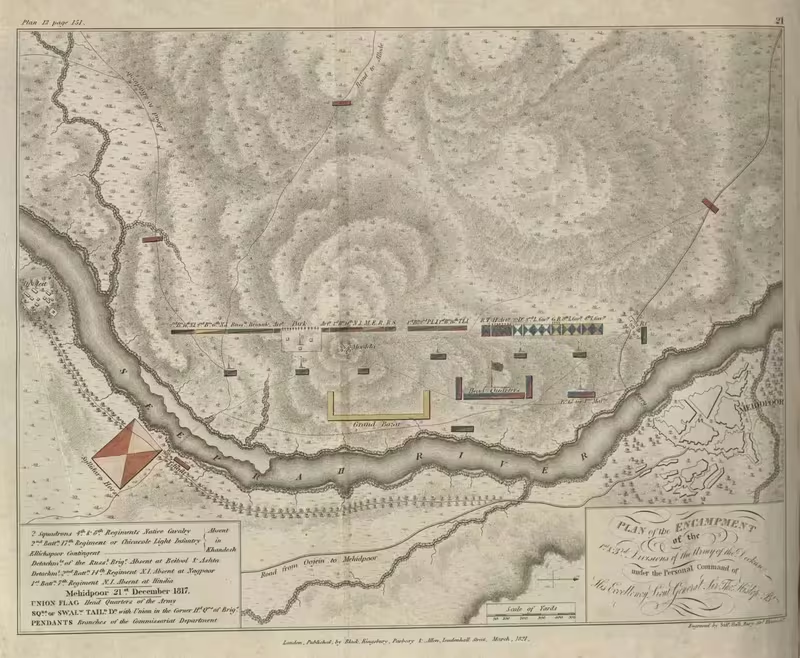
One of the most decisive engagements occurred at Mehidpur on December 21, 1817. General Hislop's forces confronted the army of Holkar, one of the major Maratha chiefs. Despite the Marathas' numerical advantage and strong defensive positions, British artillery bombardment and disciplined infantry advances broke the Maratha lines. The battle demonstrated the tactical superiority of British military methods: coordinated artillery preparation, steady infantry advances with bayonet charges, and cavalry exploitation of breakthroughs.
The defeat at Mehidpur effectively eliminated Holkar as an independent military force. The subsequent Treaty of Mandasaur forced Holkar to cede territories and accept British paramountcy, transforming one of the major Maratha houses into a subsidiary state.
Fall of Nagpur
In eastern Maharashtra, British forces under Colonel Doveton moved against Nagpur, seat of the Bhonsale dynasty. The assault on Nagpur demonstrated British capabilities in siege warfare and urban combat. Despite the city's fortifications, British artillery reduced key defensive positions, and disciplined infantry assaults captured strategic points. The fall of Nagpur brought another major Maratha house under British control.
Campaign Against the Peshwa
The campaign against Peshwa Baji Rao II, the nominal head of the Maratha confederacy, proved more protracted. The Peshwa initially attempted to coordinate resistance from Pune, but British forces methodically isolated and defeated his armies. A series of engagements throughout 1818 progressively reduced the Peshwa's power.
British cavalry charges, including the famous action of December 16, 1817, by the 6th Regiment of Bengal and 6th Regiment of Madras Light Cavalry, shattered Maratha formations. The Peshwa's forces, despite their numbers and traditional fighting spirit, could not withstand the combination of British firepower, discipline, and tactical coordination.
Operations Around Indore
The strategic city of Indore and its surrounding territories saw significant military operations in early 1818. British forces methodically reduced Maratha strongpoints, captured fortifications, and secured lines of communication. The military operations around Indore in February 1818 illustrated the comprehensive nature of the British campaign—not merely defeating armies in the field, but systematically occupying and administering conquered territories.
Reduction of Fortresses
Throughout the war, British forces demonstrated their superiority in siege warfare. Fortresses that had held against previous attackers fell to British artillery and engineering expertise. The capture of strategic forts like Belgaum secured British control over key routes and administrative centers, making it impossible for Maratha forces to maintain organized resistance.
Participants
British Leadership
Governor-General Lord Hastings (Francis Rawdon-Hastings) was the principal architect of British victory. An experienced military officer and administrator, Hastings recognized that eliminating Maratha power was essential for British supremacy in India. He coordinated the multi-front campaign with strategic vision, ensuring that British forces moved simultaneously against all major Maratha centers, preventing them from supporting each other.
General Thomas Hislop commanded British forces in central India and led the critical campaign against Holkar. His victory at Mehidpur was one of the war's decisive battles. Hislop's combination of aggressive tactics and sound logistics exemplified British military effectiveness during the conflict.
Colonel Doveton led the successful assault on Nagpur, demonstrating the British capability to capture fortified cities. His operations showed how British forces could adapt to different military challenges, from open battle to urban warfare.
Maratha Leadership
Peshwa Baji Rao II was the nominal head of the Maratha confederacy and ruler of Pune. His opposition to British control was undermined by his political weakness and inability to unite the Maratha chiefs. His defeat and subsequent abdication marked the formal end of the Peshwa institution that had dominated Maratha politics for over a century.
Maharaja Jaswant Rao Holkar II led one of the major Maratha houses. His defeat at Mehidpur effectively ended Holkar's independence. The subsequent treaty forced him to accept British suzerainty and cede significant territories.
The Bhonsale Raja of Nagpur faced both external British pressure and internal succession disputes. The fall of Nagpur to British forces ended the Bhonsale's independence and brought their territories under Company control.
Daulat Rao Scindia of Gwalior, having been defeated in the Second Anglo-Maratha War, initially remained neutral but was eventually forced to sign the Treaty of Gwalior, confirming British paramountcy over his territories.
The Pindaris
The Pindari bands, while not a formal political entity, played a role in the war's outbreak. Leaders like Karim Khan and Wasil Mohammed commanded significant forces of irregular cavalry. However, the Pindaris proved unable to stand against organized British military operations and were systematically suppressed during the campaign.
Aftermath
Immediate Consequences
The war's conclusion in April 1819 brought about immediate and far-reaching changes to the political structure of India. The Peshwa's office was abolished, ending a dynasty that had ruled the Maratha confederacy since the early 18th century. Baji Rao II was pensioned off and exiled to Bithur near Kanpur, where he lived until his death in 1851.
The major Maratha houses—Scindia, Holkar, and Bhonsale—were reduced to subsidiary states under British paramountcy. Through the Treaties of Gwalior, Mandasaur, and other agreements, these rulers ceded large territories to the British and accepted resident British officials at their courts. While they retained nominal independence and administrative control over reduced territories, their foreign relations and military affairs came under British supervision.
Territorial Gains
The British East India Company acquired vast territories through the war. The Peshwa's domains, including Pune and surrounding regions, came under direct British administration. Strategic fortresses, key trade routes, and productive agricultural regions were incorporated into Company territories. The acquisition of these central Indian territories linked British possessions in the Deccan with those in northern India, creating territorial continuity that strengthened British administrative control.
Administrative Reorganization
The Chhatrapati (the Maratha king), represented by Pratap Singh, was retained as Raja of Satara, but with purely symbolic authority and under complete British supervision. This arrangement allowed the British to claim they were respecting Maratha traditions while ensuring real power remained with the Company.
The British moved quickly to establish administrative structures in newly acquired territories. Resident officials were appointed to the courts of subsidiary rulers. Revenue collection systems were reformed or replaced with British models. The Company's administrative machinery expanded to govern the vastly enlarged territories under its direct or indirect control.
Suppression of the Pindaris
The war achieved its ostensible objective of suppressing the Pindari bands. Through military operations and diplomatic pressure on Indian rulers who had sheltered or employed Pindaris, the British eliminated this source of instability. Some Pindari leaders were killed in combat, others were captured and executed or imprisoned, and many disbanded their forces and accepted British authority.
Historical Significance
End of Maratha Power
The Third Anglo-Maratha War marked the definitive end of the Maratha Empire as a political and military force. The Marathas had been the last major indigenous power capable of challenging European colonial expansion in India. Their defeat removed the final significant obstacle to British supremacy over the subcontinent.
The Maratha confederacy had represented a distinctly Indian form of political organization that had successfully competed with Mughal and British power for decades. Its elimination demonstrated that traditional Indian military systems could not withstand the combination of European military technology, organizational methods, and financial resources deployed by the British East India Company.
Establishment of British Paramountcy
With the Marathas defeated, the British East India Company became the paramount power in India. No remaining Indian ruler possessed the military capability or political authority to challenge British dominance. While many princely states retained nominal independence, they did so only through British tolerance and under conditions of British suzerainty.
The war established the pattern of indirect rule through subsidiary alliances that would characterize British control over much of India until 1947. Indian princes ruled their states but under British supervision, with British residents at their courts, British control over foreign relations, and British intervention in internal affairs when deemed necessary.
Prelude to the British Raj
The Third Anglo-Maratha War created the conditions for the formal establishment of the British Raj. With no significant Indian power remaining to challenge them, the British could now focus on consolidating and administering their vast Indian territories. The military and political dominance established through this war would endure until Indian independence in 1947.
The expansion of British territory and influence following the war necessitated a larger administrative apparatus, more extensive military deployment, and deeper British involvement in Indian affairs. These developments set the stage for the transformation of the East India Company's commercial empire into the formal imperial administration of the British Crown after 1858.
Military Lessons
The war demonstrated the decisive advantages of European military organization, technology, and tactics over traditional Indian methods. British superiority in artillery, disciplined infantry tactics, coordinated multi-arm operations, and logistics proved overwhelming. These lessons were noted by Indian observers and would later influence independence movement strategies, which largely avoided direct military confrontation with British forces until they had been significantly weakened by World War II.
Legacy
Historical Memory
The Third Anglo-Maratha War occupies a complex position in Indian historical memory. For Maratha descendants and in Maharashtra, it represents the tragic end of Maratha independence and power. The war marked the culmination of Maratha decline from the empire's peak in the mid-18th century, when Maratha forces ranged across most of India, to complete subjugation by a foreign power.
In the broader narrative of Indian history, the war is understood as a crucial step in the establishment of British colonial rule. It demonstrated how indigenous political structures, however sophisticated, could be dismantled by a determined colonial power wielding superior military technology and exploiting internal divisions.
Monuments and Commemoration
Various forts, battlefields, and sites associated with the war remain throughout Maharashtra and central India. Fortifications like Belgaum fort stand as physical reminders of the conflict. While there are few formal monuments specifically to the Third Anglo-Maratha War, sites associated with Maratha history more broadly often evoke the period of resistance to British expansion.
Cultural Impact
The war and particularly the end of Peshwa rule have been subjects of Marathi literature, drama, and more recently, film and television. The conflict represents a pivotal moment in Maratha history, marking the end of their sovereignty and the beginning of colonial subjugation. Cultural works often emphasize themes of valor in defeat, betrayal, and lost independence.
Political Symbolism
During India's independence movement, the memory of pre-colonial Indian powers like the Marathas served as inspiration for nationalist resistance. Leaders often invoked the heritage of Indian empires that had resisted foreign domination, drawing implicit parallels between historical resistance to invaders and contemporary opposition to British rule.
Historiography
British Colonial Narratives
British historians of the colonial period typically portrayed the Third Anglo-Maratha War as a necessary campaign to bring peace and order to India. They emphasized the suppression of Pindari raids, the elimination of political instability, and the extension of British governance as progressive developments. The Marathas were often characterized as disunited, politically unstable, and unable to govern effectively, making British intervention both necessary and beneficial.
These narratives stressed British military superiority and organizational efficiency while downplaying the political machinations and territorial ambitions that motivated the war. The conflict was presented as virtually inevitable given Maratha weakness and British strength.
Nationalist Interpretations
Indian nationalist historians offered contrasting interpretations, viewing the war as aggressive colonial expansion disguised as peacekeeping operations against Pindaris. They emphasized how the British exploited Maratha disunity, highlighting that the Marathas might have successfully resisted if they had maintained the unity that characterized their empire at its height.
Nationalist historians also pointed out the economic exploitation that followed British conquest, arguing that the war was motivated primarily by commercial interests and imperial ambition rather than any civilizing mission.
Modern Scholarship
Contemporary historians take more nuanced approaches, examining the complex interplay of factors that led to British victory. Modern scholarship acknowledges both the genuine problems created by Pindari raids and the British use of anti-Pindari operations as a pretext for territorial expansion. Researchers have explored how internal Maratha divisions, competition among Maratha chiefs, and the legacy of earlier conflicts weakened collective resistance.
Recent work has also examined the war from multiple perspectives, including those of ordinary soldiers, affected civilian populations, and subsidiary participants beyond the main British and Maratha actors. This scholarship reveals the war as a complex event with varied causes and consequences rather than a simple narrative of colonial conquest or indigenous resistance.
Debates and Interpretations
Historians continue to debate several aspects of the war:
Could the Marathas have won with greater unity? Some scholars argue that a coordinated Maratha response might have significantly challenged British forces, while others contend that British advantages in technology, organization, and resources would have prevailed regardless.
What role did the Pindaris truly play? Debate continues over whether the Pindari threat was genuinely as significant as British sources claimed, or whether it was largely exaggerated to justify military operations.
How inevitable was British victory? Some historians view British supremacy as virtually inevitable given their military and organizational advantages, while others suggest that different political choices by Maratha leaders might have produced different outcomes.