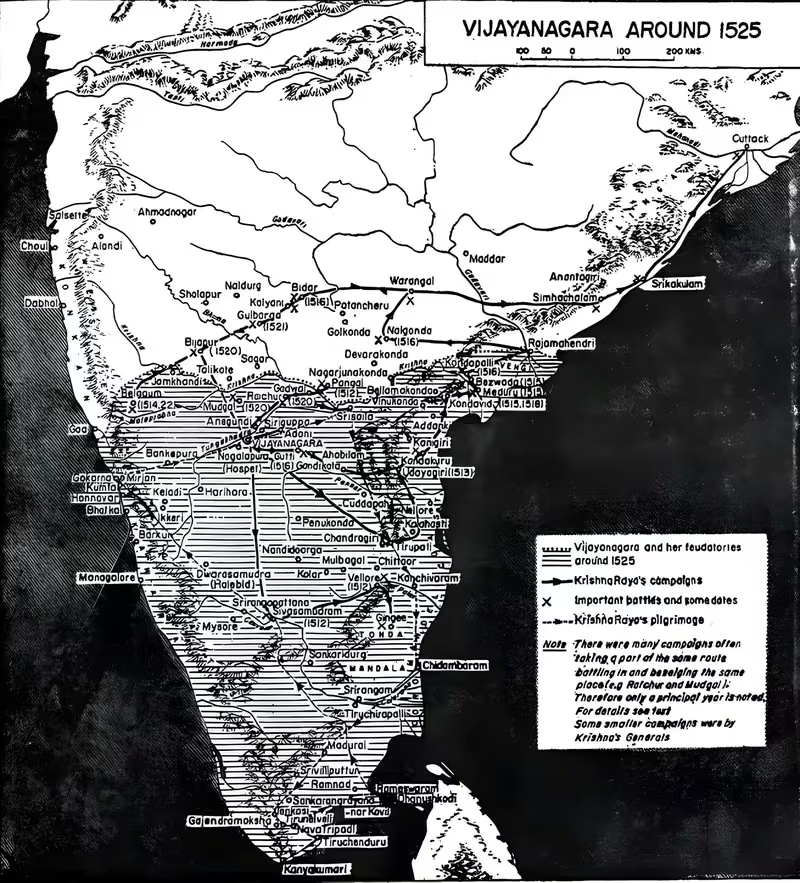
Overview
The Vijayanagara Empire, also known as the Karnata Kingdom or Kingdom of Bisnegar to contemporary European travelers, was a powerful late medieval Hindu empire that dominated southern India from 1336 to 1646. Founded on April 18, 1336, by brothers Harihara I and Bukka Raya I of the Sangama dynasty, who claimed descent from the Yadava clan of the Chandravamsa (Lunar) lineage, the empire emerged during a tumultuous period marked by the decline of earlier South Indian dynasties and the expansion of Islamic sultanates in the Deccan region.
At its zenith around 1500 CE, particularly during the illustrious reign of Krishna Deva Raya (1509-1529), the Vijayanagara Empire controlled approximately 880,000 square kilometers of territory with an estimated population of 18 million people. The empire's domains stretched from the Krishna River in the north to Cape Comorin at India's southern tip, and from the Arabian Sea coast to the Bay of Bengal, encompassing the modern states of Karnataka, Andhra Pradesh, Tamil Nadu, Kerala, Goa, and Telangana. This vast territorial expanse made Vijayanagara one of the most formidable powers in Indian history and a crucial bulwark preserving Hindu culture and traditions during an era of significant Islamic expansion in the subcontinent.
The empire's capital, Vijayanagara (present-day Hampi), developed into one of the world's largest and most magnificent cities of its time, rivaling contemporary European capitals in size and splendor. Foreign visitors, including Persian ambassador Abdur Razzak and Portuguese travelers Domingo Paes and Fernão Nunes, left vivid accounts of the city's immense wealth, bustling bazaars, magnificent palaces, and spectacular temples. The empire's cultural achievements, particularly in architecture, literature, music, and painting, represented a remarkable renaissance that synthesized diverse South Indian traditions while fostering innovation and artistic excellence.
Rise to Power
The founding of the Vijayanagara Empire occurred against the backdrop of political fragmentation following the decline of major South Indian dynasties including the Hoysala Empire, Kakatiya dynasty, Pandya dynasty, and Yadava dynasty of Devagiri. The empire replaced or absorbed several smaller kingdoms and polities including the Kampili kingdom, Musunuri Nayaks, Reddy dynasty, Sambuvaraya, and the short-lived Madurai Sultanate. The Delhi Sultanate under Muhammad bin Tughlaq had extended its control into the Deccan, creating a power vacuum when local governors and commanders began asserting independence.
According to traditional accounts, Harihara I and Bukka Raya I had initially served as treasury officers in the Kampili kingdom before it fell to the Delhi Sultanate. The brothers were captured, taken to Delhi, converted to Islam, and sent back to the Deccan as governors. However, they soon reasserted their Hindu identity under the spiritual guidance of the revered sage Vidyaranya, who became their mentor and is credited in tradition with inspiring the establishment of a new Hindu kingdom to protect dharma and resist Islamic expansion in the south.
The brothers chose an auspicious site on the southern bank of the Tungabhadra River, where they founded their capital city on April 18, 1336. The location offered strategic advantages: natural fortifications provided by the river and surrounding rocky hills, control over important trade routes, and proximity to fertile agricultural lands. The earliest inscriptional records of the empire date to 1343, confirming the establishment of administrative structures within the first decade of the dynasty's founding.
Harihara I (r. 1336-1356) and his successor Bukka Raya I (r. 1356-1377) spent their initial decades consolidating power and expanding territorial control. They conquered neighboring principalities, established administrative systems, and built diplomatic alliances. The brothers successfully repelled invasions from the Bahmani Sultanate, which had emerged as the primary Muslim power in the Deccan after breaking away from the Delhi Sultanate in 1347. These early military successes established Vijayanagara as the dominant power in the peninsula and initiated a centuries-long rivalry with the Deccan sultanates.
Golden Age
The Vijayanagara Empire reached its political, military, and cultural zenith during the late 15th and early 16th centuries, particularly under the Tuluva dynasty which succeeded the original Sangama line. The reign of Krishna Deva Raya (1509-1529) is universally regarded as the empire's golden age, representing the pinnacle of its power, prosperity, and cultural achievement.
Krishna Deva Raya ascended the throne during a challenging period when the empire faced military pressure from multiple Deccan sultanates. Through brilliant military strategy and diplomatic skill, he transformed Vijayanagara into the preeminent power in South India. His military campaigns extended the empire's borders to their maximum extent, securing control over the fertile Raichur Doab region after defeating the Bijapur Sultanate, conquering territories in Odisha, and subduing various local chiefs who had challenged imperial authority.
The emperor's court became a renowned center of learning, literature, and arts. Krishna Deva Raya himself was an accomplished scholar and poet who composed works in Telugu and Sanskrit. His Telugu work "Amuktamalyada" is considered a literary masterpiece, while his court hosted the "Ashtadiggajas" (Eight Elephants) - eight great Telugu poets who contributed to the flourishing of regional literature. The Haridasa movement in Kannada devotional music reached its height during this period, with saint-composers like Purandara Dasa and Kanaka Dasa creating thousands of devotional songs that continue to form the foundation of Carnatic music.
Architectural activity during Krishna Deva Raya's reign transformed the capital into a spectacular urban center. The construction of the magnificent Vittala Temple with its iconic stone chariot and musical pillars, expansion of the Virupaksha Temple, and numerous other religious and secular structures demonstrated both the empire's wealth and its architectural sophistication. Foreign visitors during this period described a city of extraordinary grandeur with multiple bazaar streets, each specializing in different commodities, massive fortifications, elaborate waterworks, and palaces adorned with precious materials.
The reign of Deva Raya II (1423-1446) also merits mention as another period of significant achievement. Deva Raya II reorganized the military, introduced administrative reforms, and patronized scholars from diverse backgrounds, including Muslims, reflecting the empire's policy of religious tolerance and pragmatic governance.
Administration and Governance
The Vijayanagara Empire developed a sophisticated administrative system that balanced centralized imperial authority with decentralized local governance. At the apex stood the Raya (emperor), who wielded supreme executive, military, and judicial powers. The monarch was assisted by a council of ministers and advisors who oversaw various departments including revenue, military affairs, foreign relations, and justice. The imperial bureaucracy maintained detailed records of land holdings, taxation, and administrative proceedings, as evidenced by thousands of surviving inscriptions.
The empire employed the nayankara system, an administrative and military organization similar to feudalism, where military commanders (nayakas) were granted control over provinces or districts in exchange for maintaining stipulated numbers of cavalry and infantry for imperial service. These nayakas enjoyed considerable autonomy in local administration but remained accountable to the central authority. This system allowed for efficient military mobilization while accommodating regional diversity. However, it also contained the seeds of eventual fragmentation, as powerful nayakas increasingly asserted independence during periods of weak central authority.
Territorial administration divided the empire into provinces (rajyas or mandalams), which were further subdivided into districts (kottams), and then into smaller units administered at the village level. Village assemblies retained traditional rights and responsibilities, including revenue collection, irrigation management, and dispute resolution, providing continuity with pre-imperial governance structures.
The revenue system relied primarily on land taxation, typically assessed at one-sixth to one-third of agricultural produce depending on land quality and crop type. The empire conducted regular land surveys to determine tax obligations, and maintained elaborate irrigation systems to maximize agricultural productivity. Revenue collectors at various levels ensured systematic tax collection, while royal warehouses stored grain reserves for distribution during famines.
The judicial system operated at multiple levels, from village councils handling local disputes to royal courts adjudicating major cases. The emperor served as the final court of appeal, and inscriptions record royal judgments on various matters. Legal principles drew from dharmashastra texts but adapted to local customs and practical necessities.
The empire's military organization comprised multiple components: the royal standing army maintained at the capital, provincial forces under nayakas, and auxiliary troops supplied by subordinate chiefs and allies. The army's strength lay particularly in its cavalry, for which the empire imported thousands of Arabian horses annually through trade networks. Fortification engineering reached high sophistication, with the capital's triple-layered defensive walls and numerous fortified strongholds throughout the realm.
Military Campaigns
Military prowess formed a cornerstone of Vijayanagara power, enabling the empire to maintain territorial integrity and expand its domains despite facing formidable adversaries. The empire's primary military challenge came from the Bahmani Sultanate and its successor states - the Deccan Sultanates of Bijapur, Ahmadnagar, Golconda, Berar, and Bidar. Conflicts between Vijayanagara and these Muslim kingdoms dominated South Indian politics for over two centuries, focusing particularly on control of the fertile Raichur Doab and the strategic Krishna-Tungabhadra river basins.
During the early period, Bukka Raya I successfully defended the empire against Bahmani invasions while expanding southward into Tamil country. His campaigns against the Madurai Sultanate and various Tamil chiefs established Vijayanagara authority across the peninsula. Subsequent rulers continued this pattern of defensive warfare against the Deccan sultanates punctuated by offensive campaigns to expand or secure southern territories.
Krishna Deva Raya's military campaigns exemplified strategic brilliance. His 1512 campaign against the Bijapur Sultanate captured the fortress of Raichur, a long-contested strategic position. In 1513, he defeated Sultan Mahmud Shah of Bijapur, forcing tribute payments and territorial concessions. His eastern campaigns conquered parts of coastal Andhra and Odisha, bringing the wealthy port cities and their maritime trade revenues under imperial control. The emperor's military success rested on superior organization, effective use of cavalry, sophisticated siege techniques, and the strategic deployment of firearms and artillery, technologies the empire adopted pragmatically despite their foreign origins.
The empire maintained extensive fortifications throughout its territory. The capital's defenses included three concentric lines of walls spanning several kilometers, watchtowers, bastions, and elaborate gateways. Provincial strongholds like Penukonda, Chandragiri, and Gingee featured similarly impressive fortifications. These defensive networks proved crucial in withstanding numerous sieges and invasions.
However, the empire's most consequential military engagement ended in catastrophic defeat. The Battle of Talikota (also known as the Battle of Rakshasa-Tangadi) fought on January 23, 1565, pitted the forces of the Vijayanagara Empire under Rama Raya against a confederacy of the Deccan Sultanates. Despite initial advantages, the Vijayanagara army suffered a crushing defeat when two Muslim generals in imperial service allegedly betrayed their commander at a critical moment. Rama Raya was captured and executed, and the demoralized army disintegrated. Following this victory, the sultanate armies converged on the undefended capital, sacking and destroying Vijayanagara over several months. The city never recovered, and while the empire continued for another eight decades from successive capitals, it never regained its former power or territorial extent.
Cultural Contributions
The Vijayanagara Empire presided over one of the most creative and prolific periods in South Indian cultural history, synthesizing diverse regional traditions while fostering innovation across multiple artistic domains. This cultural efflorescence reflected both the empire's material prosperity and its rulers' sophisticated patronage.
Architecture represents perhaps the empire's most enduring cultural legacy. Vijayanagara architects developed a distinctive style that evolved from earlier Chalukya, Hoysala, and Pandya traditions while incorporating innovative elements. Temples constructed during this period featured massive gopuras (gateway towers), pillared halls with intricately carved columns, elaborate mandapas (pavilions), and integration with natural landscape features. The ruins at Hampi, a UNESCO World Heritage Site since 1986, preserve spectacular examples including the Vittala Temple with its iconic stone chariot and musical pillars, the Virupaksha Temple complex, the Lotus Mahal blending Hindu and Islamic architectural elements, and numerous other religious and secular structures.
Temple construction extended throughout the empire's domains, with significant examples including the Varadaraja Temple at Kanchipuram, the Venkateshwara Temple at Tirupati, and the Tiruvannamalai Temple complex. These projects involved not only religious structures but also extensive urban planning, hydraulic engineering for tanks and aqueducts, and the development of temple-centered economic networks.
Literature flourished in multiple languages. Telugu literature experienced a golden age with royal patronage supporting poets like Allasani Peddana, Nandi Thimmana, and Tenali Ramakrishna. Krishna Deva Raya's own literary contributions elevated royal authorship to new heights. Kannada literature thrived with Haridasa composers creating thousands of devotional songs, while the Vachana literary tradition continued. Sanskrit scholarship maintained its traditional prestige, with numerous works on philosophy, poetics, and technical subjects produced at the royal court and temple establishments. Tamil literature also received patronage, particularly in southern provinces.
The Haridasa movement represented a significant development in devotional music and religious reform. Saint-composers like Purandara Dasa (often called the "father of Carnatic music") created the basic framework of Carnatic music pedagogy while composing devotional songs in Kannada that democratized religious expression and challenged ritualistic orthodoxy. This movement emphasized bhakti (devotion) over ritual and caste distinctions, contributing to social and religious reform.
Visual arts included not only architectural sculpture but also painting, with significant examples preserved in temple ceiling paintings depicting scenes from Hindu epics and Puranas. The Virupaksha Temple at Hampi contains well-preserved paintings showing courtly scenes, religious narratives, and royal processions. Manuscript illumination, textile design, and metalwork also reached high levels of sophistication.
The empire practiced remarkable religious tolerance for its era. While Hindu in identity and royal patronage, the empire allowed Jain and Buddhist communities to maintain their institutions. More notably, Muslims served in military and administrative positions, and the empire maintained pragmatic diplomatic and commercial relations with Islamic powers. This pluralistic approach facilitated cultural exchange and contributed to architectural synthesis visible in structures like the elephant stables and the Queen's Bath, which incorporate Indo-Islamic architectural elements.
Economy and Trade
The Vijayanagara Empire's economic prosperity rested on agricultural productivity, strategic control of trade routes, and active participation in Indian Ocean maritime commerce. The empire's geographic position provided access to both coastal ports and interior agricultural regions, enabling economic diversification and resilience.
Agriculture formed the economic foundation, with the empire's territories encompassing diverse ecological zones from fertile river valleys to coastal plains and dry interior plateaus. Major crops included rice, sugarcane, cotton, pepper, and various other spices. The state invested heavily in irrigation infrastructure, constructing thousands of tanks (artificial reservoirs), canals, and aqueducts to support agriculture. The elaborate hydraulic systems visible at Hampi demonstrate the sophisticated engineering applied to water management. Land revenue constituted the primary source of state income, supplemented by taxes on trade, transit duties, and various professional levies.
Trade networks extended across the Indian Ocean world, connecting Vijayanagara to markets in the Middle East, Southeast Asia, China, and later Europe. The empire controlled important ports on both the western coast (including Goa, Bhatkal, and Cannanore) and the eastern seaboard (including Pulicat and Machilipatnam), facilitating maritime commerce. Major exports included textiles (particularly cotton cloth and silk), spices (pepper, ginger, cinnamon), precious stones, hardwoods, and iron. The empire imported Arabian horses for military use (thousands annually), precious metals, coral, and luxury goods.
The capital city functioned as a major commercial hub with elaborate bazaar streets specializing in different commodities. Contemporary accounts describe markets for horses, elephants, precious stones, textiles, and general merchandise. The empire minted gold (varaha), silver (pratapa), and copper (jital) coins that facilitated commercial transactions and served as markers of sovereignty.
Urban centers throughout the empire exhibited considerable commercial activity, with temple complexes serving not only religious functions but also operating as economic institutions managing agricultural lands, financing commercial activities, and organizing artisan production. The devadana system granted tax-free land to temples, which used revenues to support religious activities, educational institutions, and charitable works while also functioning as economic enterprises.
International trade brought considerable wealth and facilitated cultural exchange. Portuguese arrival in India in 1498 opened new commercial opportunities, and the empire quickly established trade relations, supplying horses and other goods while purchasing European products and technology, including firearms. This pragmatic engagement with foreign traders characterized Vijayanagara's cosmopolitan commercial orientation.
Decline and Fall
The catastrophic defeat at the Battle of Talikota on January 23, 1565, marked the beginning of the empire's terminal decline, though the actual dissolution occurred gradually over the following eight decades. The battle's immediate consequence was the sack and destruction of the capital city Vijayanagara. Contemporary accounts describe the sultanate armies spending months systematically demolishing the city, destroying temples, palaces, and infrastructure in a devastation so complete that the city was permanently abandoned.
The empire's center shifted southward to successive capital cities: Penukonda (1565-1592), Chandragiri (1592-1604), and finally Vellore (1604-1646). However, these new capitals never replicated Vijayanagara's grandeur or symbolic power. The territorial extent shrank dramatically as the Deccan sultanates seized northern provinces while powerful nayaka governors in Tamil country and Karnataka increasingly functioned as independent rulers, though nominally acknowledging imperial suzerainty.
Multiple factors contributed to the empire's inability to recover from the Talikota disaster. Succession disputes weakened central authority, with rival claimants to the throne often seeking support from competing nayakas or even from the sultanates. The loss of the rich northern provinces and the productive Raichur Doab region severely reduced revenue resources. The fragmenting nayankara system, which had previously provided administrative efficiency and military strength, now produced virtually autonomous regional powers: the Nayaks of Madurai, Thanjavur, and Gingee in Tamil