Overview
Lahore stands as one of South Asia's most historically significant cities, having served as a capital and cultural center for over eight centuries. Located on the alluvial plains of Punjab along the Ravi River, Lahore's strategic position made it a coveted prize for successive empires and a natural hub for trade, culture, and political power.
The city gained prominence as a capital when Qutb ud-Din Aibak, founder of the Delhi Sultanate, established it as his seat of power in 1206 CE. However, it was under Mughal rule, particularly from 1586 when Akbar made it an imperial capital, that Lahore experienced its golden age. The Mughal emperors—Akbar, Jahangir, Shah Jahan, and Aurangzeb—transformed Lahore into a magnificent city adorned with gardens, palaces, mosques, and fortifications that remain architectural marvels today.
Lahore's significance continued under Maharaja Ranjit Singh's Sikh Empire (1801-1849), during which the city served as the capital of the last major indigenous empire before British colonization. Under British rule (1849-1947), Lahore became the provincial capital of Punjab and an important center of the Indian independence movement. The Partition of 1947 marked a traumatic turning point, with Lahore becoming part of Pakistan while remaining the cultural and intellectual heart of the broader Punjab region. Today, with over 13 million inhabitants, Lahore continues its legacy as one of Pakistan's most important cities, celebrated for its historical monuments, cosmopolitan culture, and enduring significance in South Asian civilization.
Etymology and Names
The etymology of Lahore remains debated among historians and linguists. The most popular mythological origin traces the name to "Lavapuri," supposedly named after Lava (or Loh), son of the Hindu deity Rama, though this connection lacks strong historical evidence and likely represents later attempts to connect the city to ancient Indian epic traditions.
The name "Lahore" first appears in historical records during the medieval period, with early Islamic historians referring to the city by this name. Some scholars suggest derivations from Persian or Sanskrit roots, though consensus remains elusive. During the brief Ghaznavid occupation, the city was temporarily renamed "Mahmudpur" after Sultan Mahmud of Ghazni, though this designation did not persist.
Throughout its history under various rulers—Ghaznavids, Ghurids, Delhi Sultans, Mughals, Sikhs, and British—the city has been consistently known as Lahore (with variations in spelling: Lahaur, Lāhōr). In modern usage, the abbreviation "LHR" serves as both the city's airport code and a popular shorthand among residents. The people of Lahore are known as "Lahoris" in English and Urdu, reflecting a strong civic identity associated with the city's rich cultural heritage.
Geography and Location
Lahore is situated in the northeast of Pakistan's Punjab province, approximately 25-30 kilometers from the border with India. The city lies at coordinates 31.5497°N, 74.3436°E, on the fertile alluvial plains created by the Ravi River, one of the five rivers that give Punjab ("Land of Five Rivers") its name. The metropolitan area covers approximately 1,772 square kilometers.
The elevation of Lahore ranges from 196 meters (643 feet) at its lowest point to 231 meters (758 feet) at its highest, creating a relatively flat urban landscape characteristic of the Punjab plains. This gentle topography facilitated urban expansion and the construction of elaborate Mughal gardens and water features that required sophisticated hydraulic engineering.
Lahore experiences a hot semi-arid climate (BSh classification), with extremely hot summers where temperatures can exceed 45°C (113°F) and mild winters with occasional temperatures dropping near freezing. The monsoon season brings most of the annual rainfall between July and September. This climate influenced architectural traditions, with Mughal builders incorporating features like high ceilings, thick walls, and water channels to combat heat.
The Ravi River historically flowed closer to the city but has changed course over centuries. Despite this, the river remained crucial for agriculture, trade, and water supply. The strategic location on Punjab's plains, with access to river systems and proximity to mountain passes leading to Central Asia, made Lahore a natural crossroads for trade routes connecting the Indian subcontinent with Afghanistan, Persia, and Central Asia. This geographic advantage contributed significantly to the city's historical importance as both a commercial hub and a strategic military position.
Ancient History
The earliest history of Lahore remains shrouded in uncertainty, with archaeological evidence suggesting human habitation in the region dating back to the early centuries of the Common Era. Most historians estimate the city's founding between the 1st and 7th centuries CE, though definitive archaeological evidence for these early periods remains limited.
Mythological accounts attempt to connect Lahore to ancient India, claiming foundation by Lava, son of Lord Rama, and suggesting the city once bore the name "Lavapuri." However, these connections appear to be later traditions lacking reliable historical documentation. Such mythological associations were common attempts by various communities to claim ancient heritage for important cities.
The earliest reliable historical references to Lahore appear in accounts by Chinese Buddhist pilgrims and later Islamic scholars. The city likely existed as a fortified settlement during the early medieval period, though it remained relatively minor compared to other urban centers in the region.
Hindu Shahi rulers controlled the area before the Islamic conquests, and Lahore may have been a provincial town in their kingdom. However, substantial documentary evidence about the city's political and social structure during this period is sparse. The transformation of Lahore from a relatively obscure settlement to a major urban center began with the arrival of Islamic rulers in the 11th century, particularly under Mahmud of Ghazni, who briefly renamed it Mahmudpur after capturing it in 1021 CE.
The Delhi Sultanate period marks the beginning of Lahore's documented prominence, with the city achieving true historical significance when it became a capital under Qutb ud-Din Aibak in 1206 CE.
Historical Timeline
Early Medieval Period (1st-11th centuries CE)
Lahore's early medieval period remains poorly documented, with the city existing as a settlement of uncertain importance. Hindu Shahi dynasties controlled the region before Islamic invasions, and the city likely served as a provincial center. The conquest by Mahmud of Ghazni in 1021 CE marked the beginning of sustained Islamic rule, though Lahore remained secondary to Ghazni and later cities.
Delhi Sultanate Era (1206-1524 CE)
Lahore's historical prominence began definitively when Qutb ud-Din Aibak, founder of the Mamluk Dynasty of the Delhi Sultanate, established it as his capital on June 25, 1206 CE. This marked the city's first confirmed status as a capital of a major empire. Throughout the Sultanate period, various dynasties—including the Khaljis, Tughlaqs, Sayyids, and Lodis—controlled Lahore, though its capital status fluctuated.
The city faced repeated Mongol invasions during the 13th and 14th centuries, necessitating continuous fortification efforts. Despite these challenges, Lahore grew as an important administrative and military center. The city's fortifications were strengthened, and it became a crucial defensive position protecting the Delhi Sultanate's heartland from Central Asian invasions.
Mughal Golden Age (1524-1752 CE)
Lahore achieved its cultural and architectural zenith under Mughal rule. After Babur's conquest of northern India, the city gained importance, but it was Emperor Akbar who elevated Lahore to imperial capital status on May 27, 1586 CE. Akbar extensively rebuilt and expanded the Lahore Fort, transforming it into a magnificent palace complex that still stands as a UNESCO World Heritage Site.
Emperor Jahangir (1605-1627) particularly favored Lahore, dying near the city in 1627. His tomb, located in the Shahdara Bagh, exemplifies Mughal funerary architecture. Under Shah Jahan (1628-1658), Lahore received some of its most iconic monuments, including the Shalimar Gardens (completed 1641-1642), designed as a royal retreat featuring sophisticated hydraulic engineering with 410 fountains.
Aurangzeb (1658-1707) commissioned the Badshahi Mosque in 1671-1673, which became the world's largest mosque for over three centuries, capable of accommodating 100,000 worshippers. The mosque's completion marked the culmination of Mughal architectural achievement in Lahore.
As Mughal power declined in the 18th century following Aurangzeb's death, Lahore passed through various hands including Persian invader Nadir Shah (1739) and Afghan ruler Ahmad Shah Durrani, before ultimately falling under Sikh control.
Sikh Empire (1799-1849 CE)
Maharaja Ranjit Singh captured Lahore in 1799 and formally declared it the capital of his Sikh Empire on April 12, 1801 CE. Under Ranjit Singh's forty-year reign, Lahore experienced modernization and relative prosperity. The Maharaja maintained the city's cosmopolitan character while adding Sikh architectural elements to existing structures, including the golden domes on the Lahore Fort's Sheesh Mahal.
Ranjit Singh's court attracted European adventurers, traders, and military experts who helped modernize his army and administration. The city prospered as the center of the last major indigenous South Asian empire before British colonization. However, following Ranjit Singh's death in 1839, political instability and succession disputes weakened the empire.
British Colonial Period (1849-1947 CE)
The British East India Company annexed Punjab after the Second Anglo-Sikh War in 1849, making Lahore the provincial capital. The British established modern infrastructure including railways (Lahore became a major rail hub), telegraph systems, and colonial administrative buildings. The Lawrence and Montgomery Halls, Government College, and the High Court represent British architectural contributions.
Lahore became an important center of the Indian independence movement, with numerous political activities and protests. The city witnessed significant events including the 1929 execution of Bhagat Singh and the 1940 Lahore Resolution (Pakistan Resolution), which called for independent Muslim-majority states and became the basis for Pakistan's creation.
Partition and Modern Era (1947-Present)
The Partition of India in August 1947 was catastrophic for Lahore. Designated as part of Pakistan despite its proximity to the border, the city experienced massive communal violence and population exchanges. The Hindu and Sikh populations largely fled to India, while Muslim refugees from Indian Punjab arrived in enormous numbers. The metropolitan corporation status was granted on February 3, 1890, and continues today.
Since independence, Lahore has remained the capital of Pakistani Punjab and the country's second-largest city. It has grown into a major industrial, educational, and economic center while preserving its historical monuments and cultural heritage.
Political Significance
Lahore's political importance spans eight centuries, with the city serving as a capital under multiple dynasties and empires. The establishment of Lahore as capital by Qutb ud-Din Aibak in 1206 CE initiated its role as a major power center. Throughout the Delhi Sultanate period, control of Lahore represented control of Punjab, the gateway to the Indian subcontinent from Central Asia.
Under the Mughals, Lahore's political significance reached its peak. As an imperial capital from 1586, the city hosted the emperor's court, served as the center of provincial administration, and functioned as a launching point for military campaigns into Kashmir and Central Asia. The city's fortifications, administrative buildings, and royal residences reflected its status as one of three major Mughal capitals alongside Delhi and Agra.
The Sikh Empire's establishment of Lahore as capital in 1801 represented the last indigenous South Asian empire's power center. Maharaja Ranjit Singh's court in Lahore conducted diplomatic relations with British India, Afghanistan, and China, demonstrating the city's continued political relevance.
Under British rule, Lahore served as the administrative capital of Punjab province, one of British India's most important provinces. The city housed the provincial legislature, High Court, and administrative offices, making it a center of colonial governance. During the independence movement, Lahore's political importance was symbolized by the 1940 Lahore Resolution, which became the founding document for Pakistan.
Since 1947, Lahore has remained the provincial capital of Pakistani Punjab, the country's most populous and politically influential province. The city continues to play a crucial role in Pakistani politics, hosting 30 provincial assembly members and 14 national assembly constituencies.
Religious and Cultural Importance
Lahore developed as a major center of Islamic culture and learning from the medieval period onward. The city is particularly associated with Ali al-Hujwiri, an 11th-century Persian Sufi saint known as Data Ganj Bakhsh (Bestower of Treasures), whose shrine remains one of South Asia's most visited Sufi sites. He is considered Lahore's patron saint, and his teachings significantly influenced the spread of Sufism in the subcontinent.
The Mughal period established Lahore as a center of Indo-Islamic culture, synthesis of Persian, Central Asian, and Indian traditions. The city attracted poets, scholars, artists, and musicians to the imperial court. Mughal architectural traditions, visible in the city's numerous mosques, gardens, and palaces, represent the culmination of Islamic architectural achievement in South Asia.
Under Sikh rule, Lahore maintained its multicultural character with Hindu, Muslim, and Sikh communities coexisting, though tensions existed. Ranjit Singh's court was notably cosmopolitan, with Muslims serving in high positions despite Sikh political dominance.
British colonial rule brought Christian missionary activity and Western educational institutions, adding another layer to Lahore's religious and cultural complexity. Government College and other institutions established during this period became centers of modernist thought and intellectual activity.
The city emerged as a crucial center for Urdu literature and poetry, with numerous renowned poets and writers associated with Lahore. The city's role in film, theater, and music made it a cultural capital of undivided India, a position it maintains in Pakistan today. According to recent data, Lahore's population is approximately 94.7% Muslim, 5.14% Christian, with small minorities of Ahmadiyya, Hindu, and Sikh residents.
Lahore's designation as a UNESCO Creative City and member of the League of Historical Cities recognizes its ongoing cultural significance and commitment to preserving its heritage while fostering contemporary artistic production.
Economic Role
Lahore's geographical position on Punjab's fertile plains and its location on trade routes connecting the Indian subcontinent with Central Asia established it as a commercial hub from medieval times. The city served as a marketplace for agricultural products from the surrounding region and manufactured goods from across the Mughal Empire.
Under Mughal rule, Lahore became a center for various crafts and industries, including textile production (particularly silk and cotton fabrics), metalwork, jewelry, and miniature painting. The royal ateliers produced luxury goods for the imperial court and wealthy patrons. The city's karkhanas (workshops) employed skilled artisans whose techniques were passed down through generations.
The British period brought modern industry and infrastructure. Railway connections established Lahore as a major transport hub, facilitating trade and commerce. The colonial government established various industries, and the city became the commercial capital of Punjab.
Since Pakistani independence, Lahore has developed into one of the country's major industrial and economic centers. The current GDP (PPP) is estimated at $84 billion as of 2019, making it a significant economic contributor to Pakistan's economy. The city hosts diverse industries including textiles, manufacturing, information technology (exemplified by the Arfa Karim Technology Park), pharmaceuticals, and services.
The Lahore Development Authority oversees urban development and economic planning. The city serves as headquarters for numerous Pakistani banks, corporations, and educational institutions. Tourism related to historical monuments and cultural heritage represents an increasingly important economic sector.
Lahore's literacy rate of 81% (as of 2023) and numerous universities contribute to a skilled workforce that supports economic growth. The Allama Iqbal International Airport connects the city to global markets, facilitating international trade and business connections. The city's economic growth rate of 8.06% reflects its continuing importance as an economic powerhouse in Pakistan.
Monuments and Architecture
Lahore's architectural heritage represents one of the richest collections of historical monuments in South Asia, spanning multiple periods and styles. The city's monuments reflect Persian, Central Asian, and Indian influences synthesized into distinctive Indo-Islamic architectural traditions.
Lahore Fort (Shahi Qila): Originally founded during the Ghaznavid period and extensively rebuilt by Akbar between 1556-1605, the fort complex encompasses 20 hectares containing palaces, halls, and gardens. Notable structures include the Sheesh Mahal (Palace of Mirrors) adorned with thousands of mirror fragments, the Naulakha Pavilion, and the Picture Wall featuring decorative tilework. Shah Jahan added several marble structures reflecting his architectural preferences. The fort, along with Shalimar Gardens, achieved UNESCO World Heritage status in 1981, with boundary extensions in 2009.
Shalimar Gardens (Shalimar Bagh): Commissioned by Shah Jahan in 1641-1642, these terraced Mughal gardens exemplify Persian charbagh design adapted to the Mughal context. The complex features three descending terraces with 410 fountains, marble pavilions, and sophisticated hydraulic systems drawing water from the Ravi River through an extensive canal network. The gardens represent the apex of Mughal landscape architecture and garden design.
Badshahi Mosque: Built by Aurangzeb in 1671-1673, this mosque remained the world's largest for over 300 years. Constructed of red sandstone with marble inlay, the mosque features four 55-meter minarets and a massive courtyard capable of accommodating 100,000 worshippers. The architecture exemplifies late Mughal style with monumental scale and elegant proportions.
Wazir Khan Mosque: Completed in 1641 during Shah Jahan's reign, this mosque is celebrated for its elaborate fresco work, featuring vibrant Persian-style tile decoration (kashi kari) and calligraphy covering nearly every surface. Unlike the monumental Badshahi Mosque, Wazir Khan Mosque represents intimate, detailed decorative traditions.
Hazuri Bagh: This formal garden between Lahore Fort and Badshahi Mosque was created by Maharaja Ranjit Singh in 1818. The garden represents Sikh architectural contributions to Lahore's landscape, maintaining continuity with Mughal garden traditions while adding Sikh elements.
British colonial architecture includes the High Court, General Post Office, Lahore Museum, and numerous educational institutions, representing Victorian Gothic and Indo-Saracenic architectural styles. These buildings created the administrative and civic infrastructure of colonial Lahore.
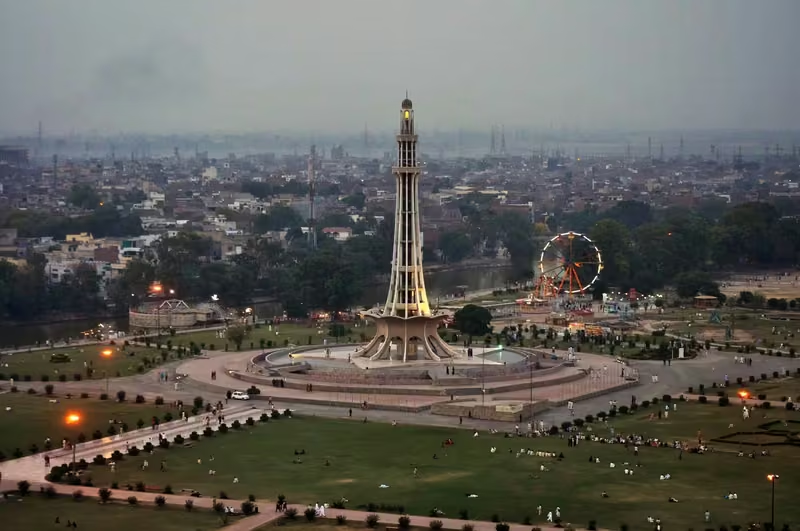
Modern monuments include Minar-e-Pakistan (Pakistan Monument), commemorating the 1940 Lahore Resolution, completed in 1968. The contemporary structure rises 62 meters and has become an iconic symbol of Pakistani nationalism.
The designation of Lahore Fort and Shalimar Gardens as UNESCO World Heritage Sites (reference 171-002) under cultural criteria (i), (ii), and (iii) recognizes their outstanding universal value as masterpieces of human creative genius, exhibiting important interchange of values, and bearing exceptional testimony to cultural traditions of Mughal civilization.
Famous Personalities
Lahore has been associated with numerous influential historical figures across different periods. Ali al-Hujwiri (c. 1009-1077), known as Data Ganj Bakhsh, was an early Sufi saint whose teachings and tomb established Lahore as an important center of Sufism. His work "Kashf al-Mahjub" (Unveiling the Veiled) remains an influential Sufi text.
During the Mughal period, several emperors maintained close connections with Lahore. Emperor Akbar (r. 1556-1605) made Lahore his capital and invested heavily in the city's development. Emperor Jahangir (r. 1605-1627) spent considerable time in Lahore and died near the city in 1627; his tomb remains a significant monument. Shah Jahan (r. 1628-1658) commissioned some of Lahore's most magnificent structures before moving the capital to Delhi.
Maharaja Ranjit Singh (1780-1839), founder and ruler of the Sikh Empire, made Lahore his capital in 1801 and ruled for forty years. His reign represents the last major indigenous empire in the region, and his court attracted diverse personalities including European adventurers and military experts.
During the colonial and independence period, Lahore was home to numerous writers, poets, and political figures. Allama Muhammad Iqbal (1877-1938), philosopher-poet and spiritual father of Pakistan, lived much of his life in Lahore. The international airport bears his name.
The city was associated with several martyrs of the independence movement, including Bhagat Singh (1907-1931), executed in Lahore for revolutionary activities against British rule. The 1940 Lahore Resolution, presented by A.K. Fazlul Huq and supported by Muhammad Ali Jinnah, was a pivotal moment in the Pakistan movement.
In literature and arts, Lahore produced or hosted numerous Urdu poets, novelists, and artists who shaped South Asian cultural production. The city's cosmopolitan character and educational institutions fostered intellectual and artistic creativity across generations.
Decline and Revival
Lahore experienced periods of decline, particularly during the 18th century following Aurangzeb's death in 1707. The weakening of Mughal central authority led to invasions by Persian ruler Nadir Shah (1739) and Afghan ruler Ahmad Shah Durrani (multiple invasions 1748-1767), causing destruction and instability. The city changed hands repeatedly, and its magnificent monuments suffered neglect and damage.
The Sikh conquest and establishment of Lahore as capital under Ranjit Singh (1799-1801) initiated a revival. Though the Sikh period saw some repurposing of Mughal structures for military use—including the use of Lahore Fort as a garrison and Badshahi Mosque as a gunpowder magazine and stable—the city regained stability and prosperity. Ranjit Singh's forty-year reign brought economic growth and urban development, though in different styles than the Mughal period.
British annexation in 1849 brought modern infrastructure including railways, telegraphs, piped water supply, and educational institutions, facilitating a different form of urban development. The colonial government recognized the historical value of Mughal monuments and initiated some conservation efforts, though motivated partly by orientalist interests. The establishment of the Lahore Museum (1894) and archaeological surveys represented early heritage preservation efforts.
The trauma of Partition in 1947 represented another major disruption. Massive population displacement, communal violence, and the sudden departure of Hindu and Sikh populations who had been integral to the city's economy and culture created enormous challenges. The influx of Muslim refugees from Indian Punjab transformed the city's demographic composition entirely.
Post-independence Pakistan gradually revived Lahore's economy and cultural life. Recognition of the city's heritage led to conservation efforts, particularly after UNESCO designated Lahore Fort and Shalimar Gardens as World Heritage Sites in 1981. Modern Lahore balances its role as a major metropolitan center with preservation of its historical character. The Lahore Development Authority and Lahore Metropolitan Corporation oversee urban development, though rapid growth presents ongoing challenges for heritage conservation.
The designation as a UNESCO Creative City and member of the League of Historical Cities reflects international recognition of Lahore's successful balance between historical preservation and contemporary urban development.
Modern City
Contemporary Lahore is Pakistan's second-largest city with a metropolitan population exceeding 13 million (as of latest census data), making it the 27th largest urban area globally. The city serves as the capital of Punjab Province, Pakistan's most populous province, and functions as a major economic, educational, and cultural hub.
The metropolitan area spans 1,772 square kilometers divided into 10 administrative zones: Ravi, Shalimar, Aziz Bhatti, Data Gunj Buksh, Gulberg, Samanabad, Iqbal, Nishtar, Wagah, and Cantonment. The Lahore Metropolitan Corporation, led by nine zonal deputy mayors (the position of mayor currently remains vacant), governs municipal services and urban development.
Lahore's literacy rate of 81% (2023) and numerous universities and colleges make it an educational center. Institutions include the historic Government College, University of Punjab, Lahore University of Management Sciences (LUMS), and the National College of Arts. The city's Human Development Index of 0.877 (2018), classified as "very high," ranks third in Pakistan.
Economic significance is reflected in the GDP of $84 billion (2019), with growth rates of 8.06%. Major industries include textiles, information technology (centered around Arfa Karim Technology Park), pharmaceuticals, manufacturing, and services. The city serves as headquarters for numerous Pakistani corporations and banks.
Infrastructure includes Allama Iqbal International Airport (LHE), providing domestic and international connections. The Lahore Metrobus rapid transit system, inaugurated in 2013, serves daily commuters. Railway connections link the city to Karachi, Islamabad, and other major Pakistani cities. The Capital City Police Lahore maintains law and order.
Tourism represents an important sector, with visitors attracted to UNESCO World Heritage Sites (Lahore Fort and Shalimar Gardens), Badshahi Mosque, Wazir Khan Mosque, Lahore Museum, and numerous other historical monuments. The city's culinary traditions, particularly its food street in Gawalmandi near the Fort, attract domestic and international tourists.
Lahore maintains its reputation as Pakistan's cultural capital, hosting literary festivals, art exhibitions, music performances, and theater. The city's cosmopolitan character (described in sources as one of Pakistan's "most socially liberal, progressive, and cosmopolitan cities") persists despite demographic changes since Partition.
Challenges include rapid urbanization, traffic congestion, air pollution (particularly severe during winter months), and pressure on infrastructure and services from population growth. Water supply issues and management of the Ravi River present ongoing environmental concerns. The Lahore Development Authority works to balance development with heritage preservation, though encroachment on historical sites remains a concern.
Despite challenges, Lahore continues to function as a major South Asian metropolis, balancing its rich historical legacy with modern urban development. The city's demographic composition is approximately 94.7% Muslim, 5.14% Christian, with smaller communities of Ahmadiyya, Hindus, and Sikhs. Official languages are Urdu and English, while Punjabi remains the native language for most residents.
Lahore's postal codes range from 53XXX to 55XXX, with the dialing code 042. Vehicle registration plates bear the LH prefix with various suffixes (LHA, LHB, LHC, etc.). The city's website (lahore.punjab.gov.pk) provides information on civic services and tourism.